
IMEI vs Phone Number: What Is the Difference?
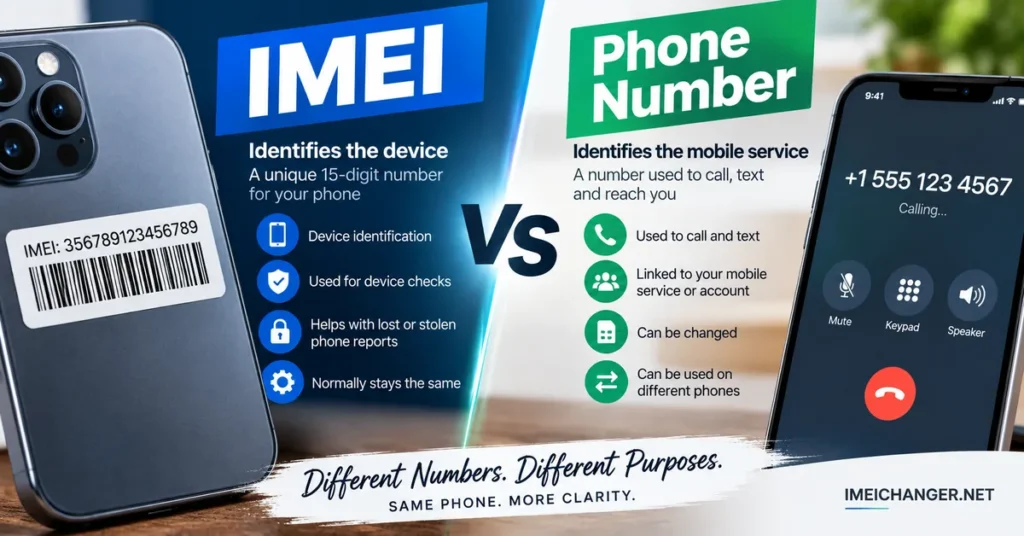
IMEI vs phone number is one of the most common points of confusion when people try to identify a mobile phone, check a used device, contact a carrier, or find a lost smartphone. Although both are connected to the same phone, they identify completely different things: the IMEI identifies the mobile equipment, while the phone number identifies the mobile service or subscriber.
That difference matters because changing your SIM card, changing your carrier, or even changing your phone number does not normally change the phone’s IMEI.
The Quick Difference Between an IMEI and a Phone Number
If you only remember one thing from this article, remember this:
IMEI = the identity of the cellular device.
Phone number = the identity used to reach the mobile service.
They work together, but they are not interchangeable.
| Identifier | What it identifies | Can it change? |
|---|---|---|
| IMEI | Cellular mobile equipment | Normally remains associated with the device |
| Phone number | Mobile service/subscriber | Yes |
| SIM card | Subscriber/service credentials | Yes |
| Serial number | Manufacturer’s individual product | Normally associated with the product |
| EID | eSIM hardware environment | Device-dependent |
This is why a carrier can associate a particular phone number with an account while the phone itself has a separate IMEI.
What Is an IMEI?
IMEI stands for International Mobile Equipment Identity.
It is a device identifier associated with cellular mobile equipment. A standard IMEI is normally 15 digits long, and phones supporting multiple cellular connections may display more than one IMEI.
The IMEI is useful when the question is about the device itself.
For example, an IMEI can be relevant when:
- Identifying a mobile device
- Checking available device information
- Investigating a used phone
- Contacting a carrier about a device
- Investigating reported device status
- Troubleshooting certain cellular problems
- Checking whether a device may have a restricted or reported status
If you want to investigate information associated with a particular IMEI, the IMEI Lookup Tool is a better starting point than trying to use the phone number.
What Is a Phone Number?
A phone number is associated with the mobile service, not the physical identity of the handset.
It is the number people use to:
- Call you
- Send you SMS messages
- Identify your mobile service
- Reach your cellular subscription
- Communicate with your mobile account
The important distinction is that the phone number belongs to the service relationship, while the IMEI belongs to the mobile equipment.
That is why you can take the same SIM card and move it from one compatible phone to another. Your phone number can remain the same even though the IMEI associated with the handset has changed.
Conversely, you can keep the same phone while changing your mobile number.
The device and the service have simply changed independently.
Updated: September 8, 2026
Does Changing Your Phone Number Change Your IMEI?
No.
Changing your phone number does not normally change the IMEI of the phone.
For example, imagine you have a smartphone with:
IMEI: 356XXXXXXXXXXXX
Phone number: +1 XXX XXX XXXX
If your carrier changes your phone number, the phone can retain the same IMEI.
The reason is simple: the phone number and the device identifier belong to different systems.
The phone number represents the mobile service.
The IMEI represents the cellular equipment.
This is also why you should not expect an IMEI lookup to reveal your phone number simply because both are connected to the same device.
Does Changing the SIM Card Change the IMEI?
Normally, no.
A SIM card provides information used by the mobile network to associate a device with a subscriber or service.
The phone’s IMEI is associated with the cellular equipment.
So if you remove your SIM card and insert another compatible SIM, you have changed the service being used by the phone, but you have not normally changed the device’s IMEI.
Think of it this way:
Same phone + different SIM = usually the same IMEI.
Different phone + same SIM = usually a different IMEI.
This simple distinction explains many of the questions people have when moving a SIM between phones.
Can One Phone Number Be Used on Different Phones?
Yes.
This happens all the time.
If you remove your SIM from one phone and put it into another compatible phone, the same mobile service can be used on the second device.
The phone number can remain the same while the IMEI changes because the physical handset has changed.
For example:
Phone A
IMEI → A123…
Phone number → 555-1234
Then you move the SIM to:
Phone B
IMEI → B456…
Phone number → 555-1234
The number has stayed the same.
The device identifier has changed.
This is one of the clearest ways to understand the difference between an IMEI and a phone number.
Can One Phone Have More Than One IMEI?
Yes.
Modern phones may support multiple cellular connections, such as dual-SIM configurations.
In that situation, the device may display:
- IMEI 1
- IMEI 2
This does not mean that the phone has two phone numbers by definition.
The number of IMEIs and the number of active phone lines are related to the device’s cellular configuration, but they are not the same concept.
If you are checking a dual-SIM phone, make sure you know which IMEI you are checking.
IMEI vs Phone Number When Buying a Used Phone
This is where the difference becomes especially important.
Suppose you are buying a second-hand smartphone.
The seller gives you a phone number associated with the device.
That number alone tells you very little about the physical handset.
A phone number can be changed, transferred, disconnected, or assigned to another subscriber.
The IMEI gives you a device identifier that is much more relevant to checking the actual handset.
Before purchasing a used phone, you should therefore focus on the device’s IMEI as well as other information such as:
- Exact model
- IMEI
- Serial number
- Activation or account status
- Carrier compatibility
- Physical condition
- SIM functionality
- Proof of purchase where available
If you are specifically concerned that the device may have been reported or restricted, use the IMEI Blacklist Checker.
A clean blacklist result is useful, but it should not be treated as a complete guarantee that every aspect of a used phone is legitimate.
Can You Find an IMEI From a Phone Number?
This is where the answer needs some nuance.
A phone number by itself is not the same thing as an IMEI, and an ordinary user cannot generally convert a phone number into an IMEI.
The carrier or service provider may have systems that associate a subscriber’s service with device information, but that does not mean that a public phone-number search can simply reveal the handset’s IMEI.
This is an important distinction because many websites and searches make it sound as if a phone number can be used as a universal key to retrieve a device’s IMEI.
It cannot be treated that way.
If you are specifically trying to understand whether an IMEI can be located when you only have a mobile phone number, see our dedicated guide:
Find the IMEI Number Using a Mobile Phone Number Online
That article deals with this specific situation without confusing the phone number with the device identifier.
Can an IMEI Be Used as a Phone Number?
No.
An IMEI is not a telephone number.
You cannot normally call an IMEI, send an SMS to it, or use it as someone’s contact number.
An IMEI is a device identifier used by cellular equipment and related systems.
A phone number, on the other hand, is designed to route communications through the mobile service.
They may both contain numbers, but their functions are completely different.
Does the IMEI Identify the Person Using the Phone?
No.
The IMEI identifies the equipment, not the person.
This distinction is particularly important when discussing privacy, lost phones, used devices, or phone tracking.
An IMEI does not automatically tell you:
- The owner’s name
- The user’s home address
- The user’s email
- The person’s contacts
- Their messages
- Their current location
An IMEI-based service may provide certain device-related information depending on the database and service being used, but an IMEI should not be confused with a personal identity number.
Does the Phone Number Identify the Phone?
Not reliably.
A phone number identifies the mobile service or subscriber relationship.
The same number can potentially be used with different physical phones over time.
For example, someone could have the same phone number for several years while upgrading from one smartphone to another.
Each handset would have its own device identifiers.
This is why a phone number is not a substitute for the IMEI when you are investigating the physical device.
IMEI vs Phone Number for a Lost Phone
When a phone is lost, people sometimes assume that the IMEI and phone number provide the same type of tracking capability.
They do not.
The phone number can be useful for communication and account-related actions, while the IMEI is useful as a device identifier when dealing with carriers, reports, or device-status systems.
An IMEI should not be treated as a magic phone-location number.
If you are researching whether an IMEI can actually track a phone, our IMEI Number Tracker guide explains the difference between device identification and actual location tracking.
For a lost or stolen device, use the appropriate official account, carrier, and reporting mechanisms rather than relying on an online IMEI search to provide a live location.
What Happens to the IMEI When You Change Carriers?
Normally, nothing.
Changing your mobile carrier does not normally change the phone’s IMEI.
You may receive:
- A new SIM
- A new eSIM configuration
- A new phone number
- A different mobile plan
But the physical phone remains the same.
Therefore, its IMEI generally remains the same as well.
This is another reason the IMEI should be thought of as a device identifier, not a subscription identifier.
What Happens to the Phone Number When You Change Phones?
The opposite can happen.
You can purchase a new phone while keeping your existing mobile number.
In that situation:
Phone number = unchanged
IMEI = changed
This is probably the most common everyday example of why the two identifiers should not be confused.
You have changed the equipment but kept the service.
IMEI vs Phone Number vs SIM Card
There are actually three separate things people commonly mix together:
IMEI
Identifies the cellular equipment.
Phone number
Identifies the number used for mobile communication and is associated with the service/subscriber.
SIM
Provides subscriber-related credentials that allow the compatible device to access a mobile network.
A simple example makes the relationship clearer:
Your phone: has an IMEI.
Your SIM/eSIM service: has subscriber credentials.
Your mobile service: can have a phone number.
These components work together, but they are not one identifier.
Where Can You Find Your IMEI?
If you need the IMEI rather than the phone number, there are several places you can look.
Use *#06#
On many compatible phones, entering:
*#06#
in the dialer displays the IMEI.
Check the Phone Settings
On Android, the IMEI is commonly available somewhere under:
Settings → About Phone
The exact location depends on the manufacturer and Android version.
On iPhone, you can normally find it through:
Settings → General → About
The IMEI may also appear on the original packaging or other manufacturer-supported documentation.
If your Android phone does not display an IMEI, that is a different problem from simply not knowing your phone number. Our guide What To Do If IMEI Is Not Showing On Android covers the troubleshooting side of that situation.
What If You Only Know Your Phone Number?
If you only know your phone number, don’t assume that it is enough to perform an IMEI check.
First, try to access the phone itself and locate the IMEI through the settings or *#06#.
If you do not have access to the phone, look for legitimate documentation such as:
- Original packaging
- Purchase records
- Carrier documentation
- Device records
- Manufacturer account information where applicable
The phone number can help identify the mobile service, but it should not be treated as a replacement for the device’s IMEI.
Why Carriers Can Associate a Phone With a Number
This is an important technical distinction.
A mobile network needs to know both which subscriber/service is connecting and which cellular equipment is being used.
That creates a relationship between things such as:
- Subscriber credentials
- SIM/eSIM
- Phone number
- IMEI
- Network connection
But the existence of a relationship does not make the identifiers interchangeable.
A carrier can have records connecting a particular service with a particular device without the phone number itself becoming the IMEI.
This is also why carrier support may ask you for different information depending on the problem you are reporting.
Can You Change Your Phone Number Without Changing Your Phone?
Yes.
You can change your mobile number while continuing to use the same physical smartphone.
In that situation:
Phone number → changes
IMEI → normally stays the same
This is a useful real-world example because it demonstrates that the two identifiers are independent.
Can You Change Your IMEI Without Changing Your Phone?
The IMEI is a device identifier and should not be treated like a phone number that can simply be changed as part of normal account management.
If an IMEI is missing, invalid, or damaged following a legitimate repair or software problem, the correct objective is to diagnose and restore the device’s legitimate original information through an appropriate repair process.
Do not confuse legitimate IMEI repair with changing a device identity to bypass a blacklist, hide a stolen device, or evade carrier restrictions.
If you are dealing with a genuine missing or invalid IMEI problem, our IMEI Repair Tool guide explains the diagnostic side of the issue.
A Simple Way to Remember the Difference
Imagine your smartphone is a car.
The IMEI is more like an identifier for the vehicle itself.
The phone number is more like the contact route associated with the person using the service.
Changing the contact number does not turn the physical phone into another device.
Likewise, moving a SIM into another compatible phone does not transfer the original phone’s physical IMEI to the new handset.
The service can move.
The device can change.
The identifiers describe different parts of that relationship.
Common Mistakes About IMEI and Phone Numbers
“My phone number is my phone’s identification number.”
No. Your phone number identifies your mobile service, while the IMEI identifies the cellular equipment.
“If I change my SIM, I get a new IMEI.”
Normally, no.
The SIM and IMEI serve different purposes.
“I can use my phone number to check whether my phone is blacklisted.”
A blacklist check is generally based on the device’s IMEI, not simply the phone number.
“An IMEI can tell me where my phone is.”
Not by itself.
An IMEI is a device identifier. It should not be confused with a live location-tracking system.
“If I change phones, I automatically lose my phone number.”
Not necessarily.
You can often keep the same number while moving your service to another compatible device.
“IMEI and phone number are interchangeable.”
They are not.
They identify different parts of the mobile ecosystem.
IMEI vs Phone Number: Which One Do You Need?
The answer depends entirely on what you are trying to do.
| Your goal | More relevant information |
|---|---|
| Identify the physical cellular device | IMEI |
| Call or text someone | Phone number |
| Check device status | IMEI |
| Investigate a used phone | IMEI + other device checks |
| Change your mobile service number | Phone number |
| Contact a person | Phone number |
| Investigate a reported device | IMEI |
| Move your service to another phone | SIM/eSIM + phone number |
| Troubleshoot missing device identity | IMEI |
The easiest rule is:
If the question is about the phone itself, think IMEI.
If the question is about calling or reaching the subscriber, think phone number.
Final Answer: IMEI vs Phone Number
The difference between an IMEI and a phone number comes down to what each one identifies.
An IMEI identifies the cellular device.
A phone number identifies the mobile service or subscriber.
Changing your number does not normally change the phone’s IMEI. Moving a SIM to another phone can keep your phone number while changing the IMEI associated with the handset. That is why these two numbers should never be treated as interchangeable.
If you are checking a used smartphone, the IMEI is the identifier you should focus on when investigating the device itself. Start with the IMEI Lookup Tool or, if you are concerned about a reported device, use the IMEI Blacklist Checker.
If you only have a phone number and are trying to locate the corresponding IMEI, read our guide on finding an IMEI using a mobile phone number.
And if the problem is that the phone itself no longer displays an IMEI, use our guide to what to do when an IMEI is not showing on Android.
The key distinction is simple: your phone number connects people to your mobile service; your IMEI identifies the cellular device using that service.