
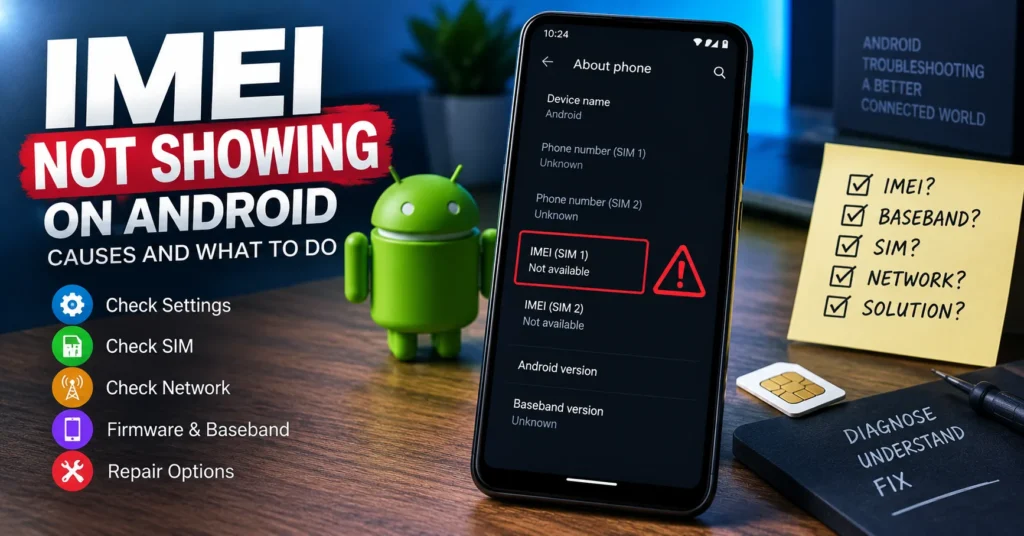
IMEI Not Showing on Android: Causes and What to Do
IMEI not showing on Android is usually a sign that the phone is not correctly retrieving or displaying its device identity information. It can appear after firmware flashing, a failed software update, a previous repair, modem problems, corrupted device configuration, or hardware damage. The important thing is not to immediately assume that the IMEI itself needs to be changed. First, determine why the phone stopped reporting its original IMEI.
A missing IMEI can also appear alongside No Service, Emergency Calls Only, Baseband Unknown, SIM problems or mobile-network failures, which makes diagnosis more complicated. The right solution depends on what else is happening on the phone.
What Does “IMEI Not Showing” Actually Mean?
An IMEI is a device identifier used by cellular networks to identify mobile equipment.
When you check an Android phone and the expected IMEI does not appear, you may see:
- IMEI Unknown
- IMEI Not Available
- Invalid IMEI
- Null IMEI
- Blank IMEI information
- No IMEI after dialing *#06#
- Missing IMEI in About Phone
- IMEI information that suddenly disappeared
These descriptions can point toward different underlying problems.
For example, IMEI Unknown + Baseband Unknown + No Service is a much stronger indication of a broader modem or firmware problem than an IMEI display problem by itself.
That distinction is important because replacing firmware, resetting the phone or using an unrelated IMEI utility will not necessarily solve the actual fault.
First: Check Whether the IMEI Is Really Missing
Before doing anything complicated, check the phone in more than one location.
On many Android devices, you can try:
*#06#
You can also open:
Settings → About Phone → Status / IMEI Information
The exact menu varies by manufacturer and Android version.
If the IMEI appears in one location but not another, the problem may be related to how Android is displaying or retrieving the information rather than a complete loss of the device’s underlying configuration.
If you want to understand the normal IMEI-checking process, see our IMEI Number Check Online guide.
Check the Baseband Version Too
This is one of the most useful checks when an Android IMEI disappears.
Open the phone’s device information and look for:
Baseband version
If a baseband version is present, record it.
If Android reports:
Unknown
or the baseband field is blank, the problem may involve the modem or firmware rather than the IMEI alone.
This matters because the cellular modem is responsible for communication between the phone’s software and the mobile network.
A phone can therefore have a missing IMEI and a baseband problem at the same time.
A useful diagnostic comparison
| What you see | What it may indicate |
|---|---|
| IMEI missing, baseband normal | IMEI/configuration issue may need investigation |
| IMEI missing + Baseband Unknown | Broader modem/firmware problem is possible |
| IMEI valid + No Service | Look beyond the IMEI |
| IMEI valid + SIM not detected | SIM, tray or hardware problem may be involved |
| IMEI valid + carrier lock | Network restriction may be the problem |
| IMEI disappeared after flashing | Firmware/configuration damage becomes more likely |
These are diagnostic clues, not automatic diagnoses.
Why Is My IMEI Not Showing on Android?
There isn’t one universal cause.
The most common situations are connected to software, modem configuration, previous repairs or hardware.
1. Failed or Incorrect Firmware Flashing
If the IMEI disappeared immediately after flashing firmware, the timing is significant.
A firmware operation can affect components responsible for cellular communication and device configuration.
This is particularly important if the phone also started showing:
- Baseband Unknown
- No Service
- Emergency Calls Only
- SIM detected but no network
- Mobile network unavailable
Do not assume that installing another random firmware package will fix the problem.
The firmware must match the exact device and variant.
2. A Failed Software Update
Sometimes an IMEI problem appears after an update rather than a manual flashing operation.
If the phone worked normally before the update and immediately lost cellular functionality afterward, record the Android version and build number before attempting additional changes.
That information can be valuable to a technician.
3. Previous Repair
A phone that has already been repaired deserves additional attention.
The problem may have appeared after:
- Motherboard replacement
- Storage repair
- Firmware servicing
- Modem-related repair
- Software modification
- Component replacement
If the motherboard was replaced, the IMEI information associated with the original board and the current hardware may not correspond in the way you expect.
4. Corrupted Device Configuration
Android devices use different protected areas and configuration systems depending on the manufacturer and chipset.
A corruption problem can affect information required for cellular operation.
This is one reason why a generic “IMEI fixer” cannot realistically be expected to work on every Android phone.
5. Modem or Baseband Failure
The modem is central to cellular communication.
If the modem firmware or related components are damaged, Android may be unable to retrieve the expected IMEI information.
In this situation, the missing IMEI may be a symptom of a larger problem, rather than the entire problem.
6. Hardware Damage
Physical damage can also produce unexpected cellular symptoms.
Possible causes include:
- Motherboard damage
- Water damage
- Failed components
- Previous board-level repair
- Modem-related hardware failure
If the IMEI disappeared after physical damage, software troubleshooting alone may not be enough.
IMEI Missing After Flashing? Start Here
If your IMEI disappeared after flashing firmware, don’t immediately start trying different IMEI applications.
Instead, write down the phone’s current condition.
Record:
Exact model number
Android version
Build number
Baseband version
IMEI status
SIM status
Network status
What firmware was installed
What happened immediately before the problem
This creates a much clearer picture for troubleshooting.
For example:
Galaxy device → firmware flashed → rebooted normally → IMEI missing → Baseband Unknown → No Service
is a very different situation from:
Android phone → IMEI visible → SIM not detected → No Service
The first points toward a possible modem/firmware/configuration problem. The second may have nothing to do with the IMEI.
Check Whether the Phone Recognizes the SIM
A missing IMEI and a SIM problem can happen at the same time, but they are not the same thing.
Check whether Android displays the SIM normally.
Look for:
- SIM detected
- SIM card status
- Network operator
- Signal bars
- Mobile network
- SIM number
- Emergency calls only
If the phone does not detect the SIM at all, test the SIM in another compatible device if possible.
If the SIM works elsewhere, the problem is more likely to be associated with the phone.
What If the IMEI Is Showing as “Null”?
A Null IMEI generally means Android is not retrieving the expected device identifier correctly.
Possible causes include:
- Firmware problems
- Modem configuration problems
- Protected device-data corruption
- Previous unsuccessful flashing
- Previous repair
- Hardware problems
Do not interpret “Null IMEI” as a request to create a new identifier.
If the device originally belonged to you and had a legitimate IMEI, the appropriate goal is to investigate restoration of the original device information.
Our IMEI Repair Tool guide covers Invalid, Null and missing IMEI situations in greater detail.
What If Android Says “IMEI Unknown”?
IMEI Unknown is another indication that the operating system cannot retrieve the expected identifier.
Check the following together:
- IMEI status
- Baseband version
- SIM detection
- Signal status
- Recent firmware changes
- Exact phone model
- Android version
If the IMEI and baseband are both unknown, don’t treat the problem as a simple display error.
It may indicate a broader cellular software or hardware issue.
What If the IMEI Is Missing but Wi-Fi Works?
This is completely possible.
Wi-Fi and cellular connectivity use different hardware and software components.
Therefore, a phone can:
- Connect to Wi-Fi
- Browse the internet
- Run apps
- Use Bluetooth
- Take photos
while still being unable to register with a cellular network.
That is why “the phone works normally except for mobile service” does not rule out an IMEI or modem-related problem.
What If the IMEI Is Correct but There Is No Signal?
This is an important situation because it prevents unnecessary IMEI repairs.
If the IMEI is displayed correctly, investigate other causes first.
Possible reasons include:
- SIM card failure
- Carrier restriction
- Network outage
- Unsupported network bands
- Modem failure
- Antenna damage
- Incorrect firmware
- Carrier lock
- Regional compatibility
- Account or service problems
A valid IMEI does not guarantee that a phone will connect to a network.
Our SIM Network Unlock PIN guide is useful if the symptoms suggest a carrier or network-lock issue rather than an IMEI problem.
Can a Factory Reset Restore a Missing IMEI?
Usually, you should not expect a factory reset to restore a missing IMEI.
A factory reset primarily removes user data and returns many Android settings to their default state.
It does not normally reconstruct damaged modem configuration or protected device information.
If the IMEI disappeared after firmware flashing, a reset may therefore accomplish nothing while still creating the inconvenience of having to configure the phone again.
Before resetting, determine what caused the problem.
Should You Flash Firmware Again?
Not automatically.
Firmware restoration can be part of legitimate troubleshooting when the problem began after an incorrect or failed software operation, but using the wrong firmware can make the situation worse.
Before flashing anything, verify:
- Exact model number
- Hardware variant
- Region
- Firmware version
- Bootloader status
- Current baseband status
- Current IMEI status
Do not select firmware simply because the phone has the same commercial name.
Different variants of the same phone can require different software.
What Is the Difference Between IMEI Repair and IMEI Rebuilding?
These terms are often mixed together online.
IMEI repair is the broader concept of diagnosing and restoring a device’s legitimate IMEI-related configuration when it has been damaged or lost.
IMEI rebuilding generally refers to rebuilding relevant configuration associated with the device, particularly in discussions involving certain Qualcomm platforms and QCN-related servicing.
If your Android phone has a missing IMEI, our IMEI Rebuilder guide explains the QCN and Qualcomm side of this subject in more detail.
Neither term should be interpreted as creating an unrelated identity for a phone.
Updated September 8, 2026. This guide has been rewritten to focus specifically on diagnosing a missing IMEI on Android, distinguishing IMEI problems from baseband, SIM, carrier and hardware faults, and separating legitimate restoration from IMEI modification.
Can an IMEI Checker Fix a Missing IMEI?
No.
An IMEI checker is designed to check or investigate an IMEI, not repair a missing identifier.
Think of the difference this way:
| Tool or topic | What it is for |
|---|---|
| IMEI Number Check | Checking an existing IMEI |
| IMEI Lookup | Investigating device information |
| IMEI Blacklist Checker | Investigating blacklist/device status |
| IMEI Repair | Troubleshooting/restoring IMEI-related problems |
| IMEI Rebuilder | Rebuilding relevant configuration in supported repair situations |
| IMEI Changer | Information about changing an IMEI |
Using the wrong category of tool can waste time and potentially create additional problems.
Can a Missing IMEI Be Related to a Blacklisted Phone?
Blacklist status and missing IMEI are different issues.
A blacklist concerns the reported or restricted status of a device identifier.
A missing IMEI means the phone is not correctly displaying or retrieving its identifier.
If you are checking a phone that you are considering buying, use an IMEI Blacklist Checker rather than assuming that a missing or unusual IMEI automatically means the device is blacklisted.
If the phone belongs to you and the IMEI disappeared after a software or hardware event, concentrate on diagnosis and legitimate restoration.
What About Tracking a Phone With a Missing IMEI?
A missing IMEI does not mean that the IMEI itself was a GPS tracking mechanism that stopped working.
The IMEI identifies the mobile device. It does not provide ordinary users with a public live location.
For a lost Android phone, location and security features such as Google’s device-finding system are the appropriate tools.
Our IMEI Number Tracker guide explains the difference between IMEI identification and actual phone-location services.
This distinction is important because many websites promise that entering an IMEI will immediately reveal a phone’s location. Be very cautious with services making that claim.
How to Preserve the Original IMEI Information
If the phone belongs to you, preserve legitimate records of its original identity.
Useful sources can include:
- Original retail box
- Purchase documentation
- Carrier records
- Service documentation
- Device account information
- Previous photographs of the device information screen
Do not publish your complete IMEI unnecessarily on public websites.
Having the original information available can make legitimate repair or service-center diagnosis much easier.
What Should You Do Before Taking the Phone for Repair?
A little preparation can save time.
Back Up Your Important Data
If the phone still works, back up your photos, contacts, documents and other important information.
Photograph the Current Status
If possible, take pictures of:
- About Phone screen
- IMEI screen
- Baseband information
- Error messages
- Network status
Record What Happened
Write down exactly when the problem started.
For example:
“IMEI disappeared immediately after firmware update.”
is much more useful to a technician than:
“Phone has no signal.”
Keep the Original Device Information
If you have the original box or purchase records, keep them with the phone when seeking service.
Don’t Experiment With Random Tools
A program advertised as an “IMEI repair tool” for every Android device may not support your phone.
Compatibility matters.
When Should You Use a Professional Repair Service?
Professional help is particularly sensible when:
- The IMEI and baseband are both missing
- The phone lost its IMEI after flashing
- The phone has motherboard damage
- The device has been previously repaired
- The phone has water or physical damage
- You don’t know which firmware belongs to the device
- The phone contains important data
- You don’t have a legitimate backup
- The problem persists after normal diagnostic checks
A technician can inspect the device as a complete system rather than assuming that the number shown by *#06# is the only issue.
A Practical IMEI Troubleshooting Checklist
Before doing anything advanced, work through this list:
1. Check the IMEI
Try *#06# and About Phone.
2. Check the baseband
Record whether a normal version is shown or whether it says Unknown.
3. Check the SIM
Confirm that Android recognizes the SIM.
4. Check network status
Look for signal, carrier and mobile-network information.
5. Identify the exact model
Record the complete model number.
6. Review recent changes
Think about updates, flashing, repairs, resets or physical damage.
7. Preserve the original IMEI
Use the box or legitimate documentation if available.
8. Avoid random firmware
Never assume another model’s firmware is compatible.
9. Avoid unnecessary IMEI modification
If the phone originally had a legitimate IMEI, the objective should be restoration rather than replacing it.
10. Escalate when necessary
If the problem involves protected device data, modem failure or hardware damage, use an appropriate professional repair route.
Frequently Asked Questions
Why is my IMEI not showing on Android?
The phone may have a firmware, modem, configuration or hardware problem. The issue can also appear after flashing firmware, a failed update or previous repair.
Why does *#06# show nothing?
If *#06# does not display the expected IMEI, Android may be unable to retrieve the device’s IMEI information. Check About Phone and the baseband status to determine whether the issue is broader.
What does Null IMEI mean?
Null IMEI generally means that Android is not correctly retrieving the expected device identifier. It can be related to firmware, modem configuration, protected device data or previous repair activity.
What does IMEI Unknown mean?
It means the phone is not correctly retrieving its expected IMEI information. If Baseband Unknown appears at the same time, investigate the modem or firmware as well.
Can a factory reset fix a missing IMEI?
A factory reset is not normally a reliable solution for a missing or invalid IMEI. It mainly resets user data and settings.
Can flashing firmware fix a missing IMEI?
Firmware restoration can sometimes be part of a legitimate repair, especially when the problem began after a failed firmware operation. However, the firmware must match the exact device and variant.
Why is my IMEI missing but Wi-Fi works?
Wi-Fi and cellular connectivity use different systems. A phone can therefore work normally over Wi-Fi while having an IMEI, modem or cellular-network problem.
Why is my IMEI correct but I have no signal?
The cause could be the SIM, carrier, network compatibility, antenna, modem, firmware, carrier lock or another hardware issue. A valid IMEI does not guarantee cellular connectivity.
Can an IMEI checker restore a missing IMEI?
No. An IMEI checker is designed to check or investigate an existing identifier. A missing IMEI requires diagnosis of the underlying device problem.
Can an IMEI rebuilder help with a missing IMEI?
On some supported devices, rebuilding relevant configuration can be part of legitimate restoration. Compatibility depends on the exact phone, chipset, firmware and available original device information.
Should I change my IMEI if it is missing?
If the phone originally had a legitimate IMEI, the appropriate objective is to investigate restoration of the original device information rather than assigning an unrelated identifier.
Final Takeaway
When an Android phone shows IMEI not showing, the most useful question is not “Which IMEI changer should I download?”
The better question is:
What caused the phone to stop reporting its original IMEI?
Start with the simplest evidence: check *#06#, look in About Phone, inspect the baseband version, confirm SIM detection and record what happened immediately before the problem appeared.
If the IMEI disappeared after flashing or a software operation, firmware and modem configuration deserve attention. If the phone also shows Baseband Unknown, the problem may be broader than the IMEI itself. If the IMEI is valid but there is still no network, investigate the SIM, carrier, network compatibility and hardware instead.
For a broader technical diagnosis, continue with our IMEI Repair Tool.
If you need to understand QCN and Qualcomm-related restoration, see our IMEI Rebuilder.
If the identifier is present and you simply want to investigate the device, use our IMEI Number Check Online guide.
And if you’re dealing with a lost or stolen phone, our IMEI Number Tracker guide explains what an IMEI can actually do — and what it cannot do.
The key is to diagnose the whole cellular system, not just the missing number.