
How to Find an IMEI Number Using a Phone Number
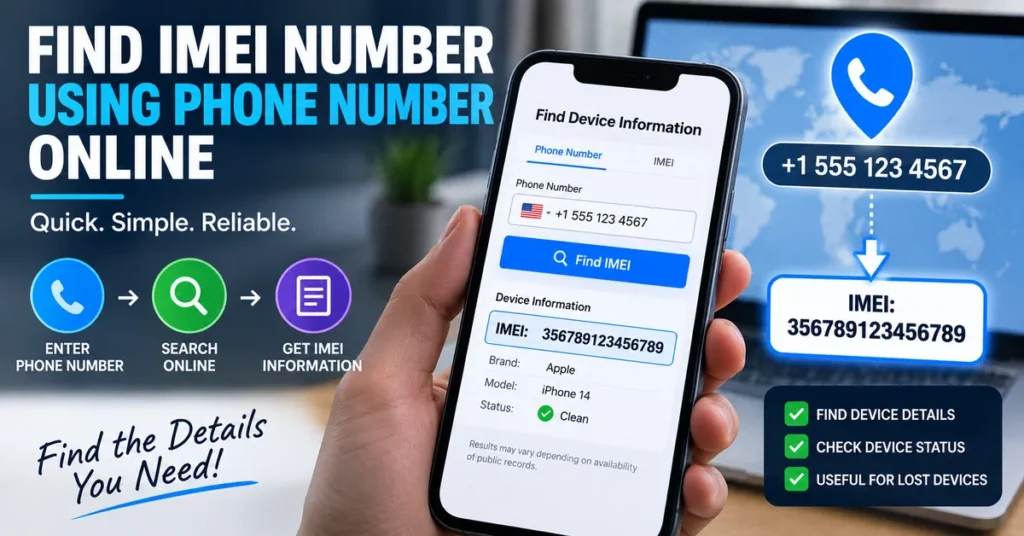
If you want to find an IMEI number using a mobile phone number, there is an important distinction to understand first: a phone number and an IMEI number identify two different things. Your phone number is associated with your mobile service or subscriber account, while the IMEI identifies the physical mobile device. In most situations, you cannot simply enter a phone number into a public website and receive the phone’s IMEI.
That does not mean the IMEI is impossible to recover when you no longer have access to the device.
If the phone is lost, stolen, broken, replaced, or unavailable, there are several legitimate places where the IMEI may still be recorded. Your carrier account, original packaging, purchase documentation, device account, or previous records may help you recover it.
The key is knowing where to look instead of relying on random phone-number-to-IMEI websites.
Phone Number vs. IMEI: They Are Not the Same Identifier
This is where much of the confusion starts.
A phone number identifies your mobile service or subscriber connection.
An IMEI identifies the cellular device.
They can be associated with one another in carrier systems, but that does not mean the relationship is publicly searchable.
For example, you can move a SIM card containing your phone number from one compatible phone to another. Your phone number can remain the same while the physical device—and therefore the IMEI—changes.
The opposite can also happen: a phone can retain the same IMEI while different SIM cards and phone numbers are used with it.
That is why a phone-number search is not the same thing as an IMEI lookup.
Can You Find an IMEI From a Phone Number Online?
Not through a normal public lookup simply by entering the phone number.
There is no universal public database where anyone can type a mobile number and retrieve the IMEI of the associated device.
The relationship between a subscriber number and a device identifier is generally maintained by the carrier or other authorized systems.
This is important for privacy and security. If anyone could discover a device’s IMEI simply by entering somebody’s phone number, device-identification information would be far easier to expose than it should be.
So if a website promises:
“Enter any phone number and instantly get the IMEI.”
be cautious.
A legitimate service may be able to help an authorized customer through an account or support process, but that is very different from a public reverse-lookup tool.
The Best Ways to Recover Your Own IMEI
If you are trying to recover the IMEI belonging to your own phone, start with the sources that already have a legitimate connection to the device.
You may not need the phone itself.
1. Check the Original Phone Box
The original packaging is one of the simplest places to look.
Phone manufacturers commonly print device identification information on the product label, often alongside a barcode.
Depending on the manufacturer and model, the label may contain:
- IMEI
- IMEI 1
- IMEI 2
- Serial number
- Model number
- EID or other device information
If you still have the box, compare the number with any other records you have.
This is particularly useful after a phone has been lost or stolen because you can retrieve the IMEI without having the physical device.
2. Check Your Purchase Receipt or Invoice
Your retailer or carrier may have recorded device information when you purchased the phone.
Look through:
- Purchase invoices
- Carrier contracts
- Device financing documents
- Order confirmations
- Repair paperwork
- Insurance documents
- Trade-in records
The IMEI is particularly useful when you need to prove which physical device was associated with a purchase or service agreement.
3. Check Your Mobile Carrier Account
If the phone was purchased through a carrier, your account may contain device information associated with your line.
The exact information displayed depends on the carrier.
Look for sections such as:
My Devices
Equipment
Device Details
Phone Information
Order History
Installment Plan
If you cannot see the IMEI yourself, contact the carrier through its official support channel.
Be prepared to verify that you are the account holder.
This is one of the most legitimate situations in which your phone number can help you recover the IMEI: not because the number mathematically reveals the IMEI, but because the carrier may have both pieces of information associated with your account.
4. Check Your Apple Account for an iPhone
If the missing device is an iPhone, check the Apple Account associated with it.
Apple provides device information through its account and device-management systems, which can be useful when you no longer have the physical iPhone available.
This is especially useful if:
- The iPhone was lost
- The iPhone was stolen
- The screen is broken
- The phone will not turn on
- You replaced the device
- You need the IMEI for a report
Remember that the Apple Account is different from simply knowing the phone number.
The phone number may help identify your mobile service, while the Apple Account can contain information associated with the actual Apple device.
5. Check Your Google Account and Android Records
Android users should also check the accounts and records associated with the device.
Depending on the phone manufacturer, model and account configuration, device information may be available through your Google-related device records or other manufacturer services.
If you still have access to the Android phone, the easiest solution is usually to check the device itself.
If you do not have the phone, check your records, original packaging and carrier account before assuming the IMEI is lost permanently.
6. If You Still Have the Phone, Don’t Use the Phone Number
If the phone is physically in your hands, there is no reason to try to recover the IMEI from your phone number.
Use the device itself.
On many compatible phones, entering:
*#06#
in the phone dialer displays the IMEI.
You may also find it in the device’s settings.
For Android, the menu is often similar to:
Settings → About Phone → IMEI
For iPhone:
Settings → General → About
The exact menu can vary according to the manufacturer, model and software version.
This is normally much more reliable than trying to identify the device indirectly.
7. What If the Phone Is Lost or Stolen?
This is probably the situation behind many searches for an IMEI using a phone number.
You have the mobile number, but the phone is gone.
In that situation, work backwards through your records.
Start With Your Carrier
Contact the carrier associated with the phone number.
Explain that you need the IMEI of your own lost or stolen device.
After verifying your identity, the carrier may be able to identify the equipment associated with your account.
Check the Phone Box
If you still have the original packaging, look at the device label.
Check Your Purchase Records
Search your email for the phone’s purchase confirmation, invoice or financing agreement.
Check Insurance Documents
If you insured the phone, the device identifier may appear in the policy or claim documentation.
Check Previous Repair Records
A service center may have recorded the IMEI when the device was repaired.
Check Your Own Device Records
If you previously saved a screenshot, note, photograph or document containing the IMEI, this may be the fastest solution.
Updated: September 8, 2026
Why a Phone Number Cannot Simply Reveal an IMEI
Think of the two identifiers as belonging to different layers of the mobile system.
Phone number → subscriber/service
IMEI → physical cellular device
A carrier can maintain a relationship between them because its network and account systems know which device is being used with a particular service.
A random website does not automatically have access to that private carrier information.
This is why legitimate IMEI recovery usually involves your own carrier account, your own device account, your own records, or the physical device itself.
What If You Have the Phone Number but Nothing Else?
If all you have is the phone number, your options become more limited.
You should not assume that an online reverse-phone lookup will reveal the IMEI.
Instead, ask yourself where the phone number originated.
Was it your carrier number?
Contact the carrier and ask about the device associated with the line.
Was the phone purchased from a retailer?
Search your email and purchase history.
Was it an iPhone?
Check the Apple Account associated with the device.
Was it an Android phone?
Check your Google and manufacturer device records.
Was the phone insured?
Check your insurance policy or previous claim documentation.
Was the phone repaired?
Contact the repair provider and ask whether the device information was recorded.
This approach is much more likely to recover the correct IMEI than entering the phone number into an unknown website.
Can a Phone Number Be Used to Track the IMEI?
A phone number is not a public IMEI tracking key.
Knowing someone’s phone number does not normally give you access to the IMEI of their device.
Similarly, knowing an IMEI does not give an ordinary user access to somebody else’s private subscriber information.
These identifiers can be related inside carrier systems, but the relationship is not intended to function as a public search tool.
Can You Find a Lost Phone Using Its Phone Number?
Finding the IMEI and finding the phone are two different tasks.
If your phone is lost, recovering the IMEI can help with identification, reporting, carrier assistance and device-status checks.
It does not automatically provide the phone’s live location.
For example, our IMEI Lookup Tool explains that an ordinary IMEI lookup is not a public GPS tracking system.
For actual device location, use the appropriate location service associated with your phone’s operating system and account.
If the phone was stolen, report it through the appropriate carrier and authorities rather than relying on websites claiming that an IMEI alone can reveal a live location.
What Can You Do Once You Recover the IMEI?
Once you have the correct IMEI, you can use it for several legitimate purposes.
Check Device Information
If you want to investigate information associated with the device, use an appropriate IMEI lookup service.
Our IMEI Number Check Online Tool is designed around this type of device check.
Investigate Blacklist Status
If the phone was lost, stolen, purchased second-hand, or has unexpected cellular problems, you may want to investigate whether the IMEI has a reported or restricted status.
See our IMEI Blacklist Checker guide for this specific purpose.
Provide the IMEI to Your Carrier
The IMEI can help your carrier identify the physical device associated with your service.
Provide the IMEI in a Loss or Theft Report
If your phone was lost or stolen, the IMEI can be useful when making a report or dealing with insurance.
Compare a Used Phone
If you are considering purchasing a used device, compare the IMEI displayed by the phone with the number supplied by the seller or printed on the original packaging.
Don’t Confuse an IMEI Lookup With IMEI Recovery
There are two separate questions:
“How do I find my IMEI?”
and
“What information can I get from an IMEI?”
The first is an IMEI recovery problem.
The second is an IMEI lookup problem.
If you already have the IMEI, there is no reason to search for it using your phone number.
Instead, you can move directly to the appropriate device-checking resource.
Our IMEI Lookup Tool explains how IMEI-based device information checks work.
What If Your Android Phone Does Not Show an IMEI?
There is another situation that can cause confusion.
You may have the phone in your hands, but the IMEI field is missing, blank, unknown or invalid.
That is not a phone-number lookup problem.
It is an IMEI/device troubleshooting problem.
In that situation, see our guide What To Do If IMEI Is Not Showing On Android.
The cause can be related to software, firmware, configuration, hardware or previous repair work, so it is better to diagnose the actual problem instead of assuming that the phone number can be used as a replacement source.
What If You Have Two IMEI Numbers?
Many modern phones support more than one cellular connection.
A dual-SIM or eSIM-capable device may therefore display:
IMEI 1
and
IMEI 2
Do not assume that they are duplicate numbers.
If your carrier asks for an IMEI, make sure you provide the identifier that corresponds to the relevant cellular connection.
When checking a used phone, compare the device information carefully rather than copying only one number without checking the phone’s configuration.
How to Keep Your IMEI Safe for the Future
The easiest way to solve an IMEI-recovery problem is to prevent it from becoming one.
When you purchase a new phone, record the following information somewhere secure:
- IMEI 1
- IMEI 2, if applicable
- Serial number
- Model
- Purchase date
- Carrier
- Order number
- Receipt or invoice
You can also keep a photograph of the original device label or box.
Do not publish the IMEI publicly or share it unnecessarily.
The goal is simply to make sure that you can retrieve your own device information if the phone disappears.
Common Mistakes When Searching for an IMEI With a Phone Number
Mistake 1: Assuming the Phone Number and IMEI Are the Same
They identify different things.
Mistake 2: Expecting a Public Reverse Lookup
A phone number does not normally provide public access to the IMEI associated with it.
Mistake 3: Trusting “Instant IMEI From Any Phone Number” Websites
Be especially cautious when a website claims it can reveal private device information from any phone number without authorization.
Mistake 4: Forgetting the Carrier
Your carrier may have legitimate records connecting your service line with the device.
Mistake 5: Ignoring the Original Box
The packaging may contain exactly the device information you are trying to recover.
Mistake 6: Confusing IMEI Recovery With IMEI Tracking
Recovering the IMEI does not locate the phone.
Mistake 7: Using the Wrong Identifier
Serial number, IMEI, EID, ICCID and phone number are different identifiers.
Frequently Asked Questions
Can I find an IMEI number using a mobile phone number?
Not through a normal public online lookup. A carrier may have the phone number and IMEI associated in its internal records and may be able to provide the device information to an authorized account holder.
Can I find my IMEI if I lost my phone?
Yes, potentially. Check your carrier account, original box, purchase records, insurance documents, repair records and manufacturer account before assuming the IMEI is unavailable.
Can I find an IMEI with only a phone number?
Usually not through a public service. If it is your own number, contact your carrier and ask whether the device associated with the line can be identified after account verification.
Is an IMEI the same as a phone number?
No. The phone number identifies the mobile service or subscriber, while the IMEI identifies the physical cellular device.
Can Google give me an IMEI from my phone number?
Do not assume that simply knowing a phone number gives you access to an IMEI. Check the device and account records associated with your own phone instead.
Can my carrier find my IMEI from my phone number?
A carrier may have records connecting your mobile service with a particular device. Whether it can provide the IMEI directly depends on the carrier, account ownership and its support procedures.
Can I find an iPhone IMEI without the iPhone?
Yes. Depending on your circumstances, you may be able to find it through your Apple Account, original packaging, purchase documentation, carrier records or other legitimate device records.
Can I find an Android IMEI without the phone?
You may be able to recover it from the original box, purchase documents, carrier records, account information or previously saved records. The exact options depend on the manufacturer and device.
Can an IMEI lookup locate my phone?
No. A normal IMEI lookup provides information associated with a device identifier; it is not a public live-location service.
What should I do if my phone was stolen?
Recover the IMEI from your records or carrier, report the theft through the appropriate channels, contact your carrier, and use your phone’s official location and security features where available.
Can I check the IMEI after recovering it?
Yes. Once you have the correct IMEI, you can use an IMEI Number Check Online Tool or investigate the device through an IMEI Lookup Tool.
Can an IMEI number be changed to solve a blacklist problem?
Changing a device identifier is not the legitimate solution to a blacklist report. If a device has been reported or restricted, resolve the underlying issue with the carrier, seller, manufacturer or other relevant organization.
Final Answer: The Phone Number Is a Clue, Not an IMEI Lookup Tool
If you are trying to find an IMEI number using a mobile phone number, don’t expect a public website to simply convert one number into the other.
The phone number identifies your mobile service.
The IMEI identifies the physical device.
Your carrier may have both pieces of information in its internal records, which is why contacting the carrier can be useful when you have lost your phone but still have the associated mobile number.
Before doing that, check the original phone box, purchase receipt, carrier account, insurance documents, repair records and your own saved device information. If the phone is an iPhone or Android device, also check the account and device-management records associated with it.
Once you recover the IMEI, you can move on to the next step: checking the device, investigating its status, or providing the identifier when reporting a lost or stolen phone.
For a general device check, use our IMEI Number Check Online Tool. For broader device information, see our IMEI Lookup Tool. If you need to investigate whether a device may have a reported or restricted status, use our IMEI Blacklist Checker.
The most important point is simple:
Your phone number does not publicly reveal your IMEI. Your carrier and your own device records are the places to start.