IMEI Check iPhone Service: How to Check an iPhone IMEI Online
An IMEI Check iPhone Service can help you investigate important information about an iPhone before buying it, troubleshooting a network problem, or trying to understand the status of a device.
Every cellular iPhone has an IMEI associated with its mobile hardware. This identifier can be useful when checking a used iPhone, investigating a reported or restricted device, confirming device information, or contacting a carrier about a phone.
However, an IMEI check is not a magic report that can reveal everything about an iPhone. The information available depends on the checking service, database, carrier, country, device model, and type of check being performed.
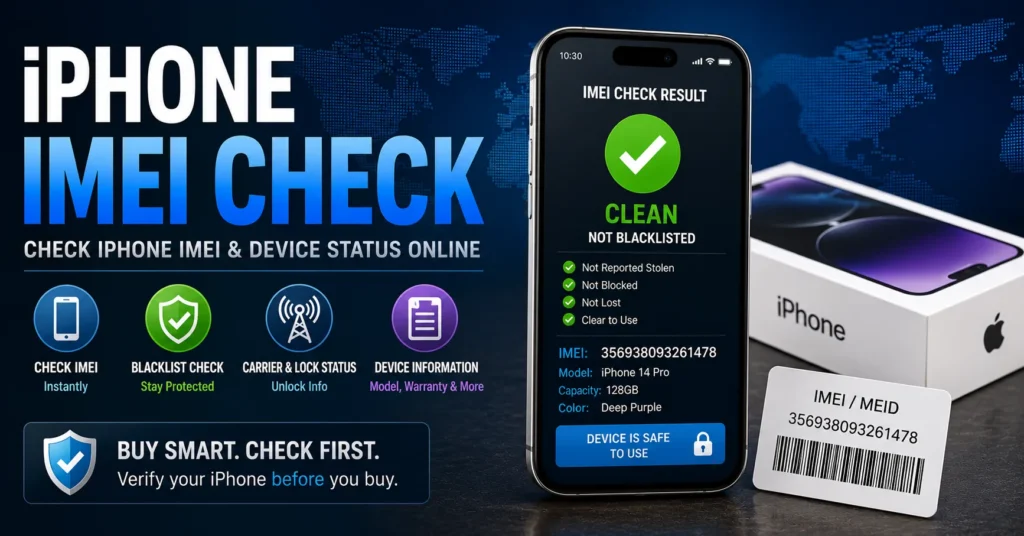
This updated guide explains how to check an iPhone IMEI online, where to find the IMEI, what information an IMEI check can provide, how to check blacklist status, how IMEI checking differs from Activation Lock and carrier-lock checks, and what you should verify before buying a used iPhone.
If you want to perform a broader device check, start with our IMEI Number Check Online Tool.
What Is an IMEI Check for iPhone?
An iPhone IMEI check is a process of using the device’s IMEI number to investigate information associated with that particular mobile device.
The IMEI stands for International Mobile Equipment Identity. It is normally a 15-digit identifier associated with cellular mobile equipment.
Unlike a phone number, the IMEI identifies the device rather than the subscriber’s mobile service.
An iPhone IMEI check can be useful when you want to:
- Identify an iPhone.
- Check device information.
- Investigate blacklist status.
- Research a used iPhone before buying it.
- Compare the IMEI shown by the phone with the IMEI provided by the seller.
- Investigate certain network problems.
- Provide device information to a carrier or repair professional.
The exact information returned by an IMEI service varies. A reputable checker should clearly explain what its database can actually verify rather than promising every possible piece of information from an IMEI alone.
Why Should You Check an iPhone IMEI?
Checking the IMEI is particularly useful when purchasing a second-hand iPhone.
A used iPhone can look perfect on the outside and still have a problem that is not immediately visible. For example, the device may have a reported cellular status, carrier restriction, ownership issue, or other limitation.
An IMEI check should therefore be part of your used-iPhone inspection.
| Check | Why It Matters |
|---|---|
| IMEI | Helps identify the cellular device. |
| Blacklist status | Can reveal whether the device may be reported or restricted in relevant databases. |
| Carrier status | Helps determine whether the phone may be restricted to a carrier. |
| Activation status | Important when buying a used iPhone. |
| Serial number | Provides another Apple device identifier. |
| Model | Confirms which iPhone you are actually purchasing. |
| Physical condition | Identifies damage or repairs that an online check cannot detect. |
How to Find the IMEI Number on an iPhone
Before performing an iPhone IMEI check, you need to find the correct IMEI.
Apple provides several ways to locate device identification information depending on the iPhone model and whether you currently have access to the operating system.
Find the IMEI in iPhone Settings
On an iPhone that you can access normally, open:
Settings → General → About
Scroll through the device information until you find the IMEI.
The About screen can also contain other useful information, such as the model name, model number, serial number, and other device identifiers.
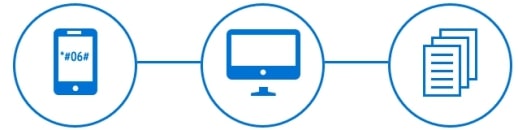
Find the IMEI With *#06#
On supported cellular devices, you can also open the Phone application and enter:
*#06#
The device may display its IMEI information on the screen.
This is one of the quickest ways to retrieve the IMEI when the phone is functioning normally.
Find the IMEI on the Original Packaging
If you do not have access to the iPhone’s settings, the original packaging may contain the device’s IMEI and serial information.
When buying a used iPhone, compare the IMEI shown by the device with the information provided by the seller and the original packaging where applicable.
Find the IMEI When You Cannot Access the iPhone
If you cannot open the device normally, additional Apple-supported device information may be available through your account, original documentation, or the device’s packaging.
If you are purchasing a used iPhone, ask the seller to provide the IMEI before completing the transaction so you can perform your checks in advance.
How to Check an iPhone IMEI Online
The basic process is straightforward.
Step 1: Find the Correct IMEI
Locate the iPhone’s IMEI through Settings, *#06#, the original packaging, or another appropriate source.
Step 2: Check the Number Carefully
An IMEI is normally 15 digits long.
Make sure that every digit is entered correctly. A single incorrect digit can produce an incorrect result or cause a checking service to reject the request.
Step 3: Use an Appropriate IMEI Checking Service
Use a service designed for the type of information you want to investigate.
For a general device check, you can start with our IMEI Number Check Online Tool.
Step 4: Review the Result
Read the result carefully rather than assuming that a single word such as “clean” answers every question about the iPhone.
Different services can have different databases and coverage.
Step 5: Confirm Important Information
If you are purchasing an expensive used iPhone, confirm important negative or uncertain results with the relevant carrier, seller, or Apple-supported device information before paying.
What Information Can an iPhone IMEI Check Provide?
The information available from an IMEI check depends on the service and database being used.
Depending on the service, you may be able to investigate information such as:
| Information | What It Can Tell You |
|---|---|
| IMEI | The device identifier submitted for the check. |
| Device model | The phone model associated with the identifier where supported. |
| Blacklist status | Whether the IMEI appears reported or restricted in the relevant database. |
| Carrier information | Possible information about the network or carrier associated with the device. |
| Device status | Additional status information where the database supports it. |
| Warranty information | Available only through services or databases that provide it. |
Do not assume that every IMEI service provides every item in this table.
In particular, an IMEI number alone does not automatically provide access to a person’s private Apple account, passwords, messages, photographs, live location, or other private information.
What an iPhone IMEI Check Cannot Tell You
This is one of the most important parts of understanding an IMEI checking service.
An IMEI check is useful, but it is not a complete diagnostic report for an iPhone.
An IMEI check does not automatically prove:
- That the seller is the legitimate owner.
- That the phone has never been repaired.
- That the battery is healthy.
- That Face ID works.
- That every camera works.
- That the display is original.
- That the phone is free from physical damage.
- That Activation Lock has been removed.
- That the phone works with every carrier.
- That the phone has no account-related restrictions.
For this reason, an IMEI check should always be combined with a physical and software inspection.
iPhone IMEI Check vs IMEI Blacklist Check
A general IMEI check and an IMEI blacklist check can have different purposes.
A general IMEI check may investigate device information, while a blacklist check focuses specifically on reported or restricted status.
| Check | Main Purpose |
|---|---|
| iPhone IMEI Check | Investigates available information associated with the iPhone’s IMEI. |
| IMEI Blacklist Check | Investigates whether the IMEI may be reported or restricted. |
| Serial Number Check | Investigates Apple device identification information using the serial number. |
| Carrier Check | Investigates carrier or network restrictions where supported. |
| Activation Status Check | Determines whether the device can be properly activated by its new owner. |
If your main concern is whether a used iPhone has a reported device status, use our IMEI Blacklist Checker guide.
How to Check If an iPhone Is Blacklisted
A blacklisted iPhone may have difficulty connecting to cellular networks where the relevant restriction is enforced.
To investigate blacklist status:
- Find the iPhone’s IMEI.
- Enter the IMEI into an appropriate blacklist checking service.
- Review the reported status.
- Investigate any negative or uncertain result.
- Contact the carrier or seller if necessary.
A “clean” result generally means that the checking service did not find the IMEI in the relevant blacklist or reported-device database at the time of the check.
It does not guarantee that the iPhone has no other problems.
For a complete explanation of blacklist results, read our IMEI Blacklist Checker guide.
What Does a Clean iPhone IMEI Mean?
A clean IMEI generally means that the identifier was not found in the particular blacklist or reported-device database being checked at the time of the search.
This is a positive sign when buying a used iPhone, but it should not be treated as a complete guarantee.
A clean IMEI does not automatically mean:
- The iPhone is carrier unlocked.
- The iPhone has no Activation Lock.
- The device has no hardware problems.
- The battery is healthy.
- The phone is original in every component.
- The seller is the legitimate owner.
- The phone is compatible with your preferred carrier.
Think of the IMEI check as one important part of the buying process, not the entire process.
What Does a Blacklisted iPhone IMEI Mean?
A blacklisted IMEI generally indicates that the device identifier has been reported or restricted in a relevant carrier or device-status database.
Possible reasons can include:
- The iPhone was reported lost.
- The iPhone was reported stolen.
- The device was associated with fraud.
- A carrier-related restriction was placed on the device.
- Another report or restriction was added by a participating organization.
The exact reason cannot always be determined from a third-party IMEI checker alone.
If you are buying an iPhone and the IMEI returns a negative result, do not simply assume that the problem can be fixed by changing the IMEI.
Contact the seller or relevant carrier and resolve the underlying issue.
Can an iPhone IMEI Check Remove a Blacklist?
No. An IMEI checking service is designed to investigate device information or status. It does not legitimately remove a blacklist from an iPhone.
Be cautious with websites claiming that an IMEI checker can automatically transform a blacklisted iPhone into a clean device.
A legitimate device-status check should not require you to replace the iPhone’s original IMEI.
If an iPhone has been reported lost or stolen, the appropriate solution is to resolve the report through the relevant carrier, seller, or legitimate owner.
IMEI Check vs iPhone Activation Lock
An IMEI check and Activation Lock are different checks.
Activation Lock is associated with Apple’s device-account security system, while the IMEI identifies the cellular device.
A clean IMEI does not automatically mean that an iPhone is ready for a new owner.
When buying a used iPhone, make sure the previous owner’s account has been properly removed and that the device can be activated normally.
Never rely on a clean IMEI result alone when purchasing a second-hand iPhone.
IMEI Check vs iPhone Carrier Lock
A carrier lock is also different from an IMEI blacklist.
A carrier-locked iPhone may be restricted to a particular network even though its IMEI is not blacklisted.
| Status | Meaning |
|---|---|
| Clean IMEI | The IMEI was not found in the relevant blacklist database. |
| Blacklisted IMEI | The device identifier may be reported or restricted. |
| Carrier Locked | The iPhone may be restricted to a particular network. |
| Activation Locked | The device may still be associated with a previous owner’s Apple account. |
| Network Incompatible | The iPhone may not support the required network or carrier configuration. |
These problems require different solutions.
If you are trying to determine whether a phone is carrier unlocked, see our guide to checking if a phone is unlocked by IMEI.
How to Check a Used iPhone Before Buying
An iPhone IMEI check is especially valuable before buying a used device.
However, you should perform several checks before handing over your money.
Check the IMEI
Find the IMEI directly on the iPhone and compare it with the information supplied by the seller.
Check the Blacklist Status
Use an appropriate IMEI blacklist check and investigate any negative result before purchasing the phone.
Check Activation Lock
Make sure the previous owner’s account has been removed and the phone can be activated by you.
Check Carrier Status
Confirm that the iPhone is compatible with the carrier and network you intend to use.
Check the Serial Number
Compare the serial number shown by the iPhone with the seller’s documentation where appropriate.
Check Battery Health
Open the battery-health information and inspect the reported condition.
Test Face ID or Touch ID
Biometric hardware should be tested before buying because an online IMEI check cannot detect every hardware fault.
Test the Cameras
Check the front and rear cameras, autofocus, flash, video recording, and other camera functions.
Test the Display
Look for dead pixels, touch problems, discoloration, cracks, and other display issues.
Test Cellular Connectivity
Insert a working SIM or use the appropriate cellular connection and confirm that the phone can connect to the network.
How to Check an iPhone IMEI Before Selling It
IMEI information can also be useful when preparing an iPhone for sale.
Before selling:
- Record the device’s IMEI for your own documentation.
- Confirm the exact model.
- Back up your personal information.
- Sign out of your Apple account where appropriate.
- Erase the device using Apple’s supported procedure.
- Remove personal SIM information.
- Keep your purchase documentation if available.
Never publish your full IMEI unnecessarily on public websites or social media.
Can You Check an iPhone IMEI Without the Phone?
Sometimes.
If you do not physically have the iPhone, you may be able to obtain its IMEI from the original packaging, purchase documentation, account information, or the seller.
However, when buying a used phone, it is better to verify the IMEI directly on the device whenever possible.
This helps ensure that the IMEI you are checking actually belongs to the phone being sold.
Can You Check an iPhone IMEI by Phone Number?
A phone number and IMEI are different identifiers.
A normal IMEI checker requires the device’s IMEI rather than simply a telephone number.
If you do not know the IMEI, first try to retrieve it from the iPhone itself, the original packaging, documentation, or another legitimate source.
Do not rely on websites promising that they can reveal a private device’s IMEI merely from a phone number without appropriate authorization.
Can an IMEI Check Find a Stolen iPhone?
An IMEI blacklist check may help determine whether an IMEI has been reported or restricted in a relevant database.
However, an IMEI check is not a live location tracker.
It cannot legitimately provide the real-time GPS location of an iPhone simply because you know its IMEI.
If your iPhone has been lost or stolen, use Apple’s supported device-location and account-security features and contact your carrier or the appropriate authorities.
Can an IMEI Check Reveal the iPhone Owner?
No legitimate public IMEI checker should be assumed to provide a private person’s identity simply from an IMEI.
Device information and personal account information are different categories of data.
An IMEI may identify the device in carrier and network systems, but that does not mean that a public checker can reveal the private owner’s name, Apple account password, messages, photographs, or other confidential information.
Can an IMEI Check Show the iOS Version?
Some device-information services may provide software information where their databases contain it, but an IMEI alone should not be treated as a guaranteed source of the iPhone’s current iOS version.
For the most accurate software information, check the iPhone directly under:
Settings → General → About
There you can see the software version currently installed on the device.
Can an IMEI Check Show the iPhone Model?
Many IMEI databases can associate an IMEI with a device model or model family.
This can be useful when purchasing a used iPhone because it provides another way to compare the seller’s description with the device information.
However, you should still inspect the phone directly and verify the model shown in its settings.
iPhone IMEI Check for Older iPhone Models
Older iPhone models can still be checked using their IMEI when the relevant service supports the device and database.
This includes many generations of iPhone, from older cellular models through newer devices.
The important point is not the age of the iPhone but whether the IMEI checking service has appropriate information for that device and the type of check you want to perform.
If you are checking an older used iPhone, pay particular attention to:
- Blacklist status
- Carrier compatibility
- Activation status
- Battery condition
- Physical damage
- Network compatibility
- Repair history
iPhone IMEI Check for Newer iPhone Models
The same general principles apply to newer iPhone models.
However, newer devices can introduce different hardware, cellular technologies, SIM configurations, and regional variants.
For a newer iPhone, an IMEI check should therefore be combined with direct device inspection and carrier compatibility checks.
Do not assume that an older IMEI-checking service contains complete information about every newer iPhone model.
What If the iPhone IMEI Is Missing?
If an iPhone does not display its expected IMEI, treat that as a separate troubleshooting problem rather than automatically assuming that the device is blacklisted.
Check the device information again and determine whether the issue is related to software, hardware, cellular configuration, or repair history.
If you are also dealing with an Android device whose IMEI has disappeared, our guide to what to do if an IMEI is not showing on Android explains the common causes and troubleshooting considerations.
For broader information about legitimate IMEI repair problems, see our IMEI Fix Tool guide.
Why an IMEI Check May Return Different Results
Different IMEI services can sometimes produce different results.
This does not necessarily mean that one of them is intentionally wrong.
Different services may use different:
- Databases
- Carriers
- Countries
- Reporting organizations
- Update schedules
- Device information sources
For this reason, treat important results carefully.
If you are about to purchase an expensive used iPhone and receive a concerning result, confirm the information with the relevant carrier or seller before completing the transaction.
Is a Free iPhone IMEI Check Reliable?
A free IMEI check can be useful for basic screening, but “free” does not automatically mean that the service has complete worldwide database coverage.
Before relying on a result, consider:
| Question | Why It Matters |
|---|---|
| What database is being used? | The source determines what information can be returned. |
| Which countries are covered? | Blacklist and carrier information can vary by region. |
| How frequently is information updated? | Device status can change after a report or resolution. |
| What does the result actually check? | A general IMEI lookup is not necessarily a blacklist check. |
| Does the service explain limitations? | Clear limitations are a sign of a more transparent service. |
Common iPhone IMEI Check Mistakes
Checking the Wrong IMEI
Dual-SIM or multi-cellular devices can have more than one IMEI. Make sure you are checking the correct identifier.
Copying the IMEI Incorrectly
One wrong digit can produce an incorrect result.
Trusting One Check Completely
An IMEI check is useful, but it should not replace a complete used-iPhone inspection.
Confusing Blacklist and Carrier Lock
A clean IMEI does not necessarily mean that the iPhone is carrier unlocked.
Ignoring Activation Lock
A phone can have a clean IMEI and still have an account or activation problem that prevents a new owner from using it normally.
Buying Before Checking
Always perform the important checks before handing money to the seller whenever possible.
Frequently Asked Questions About iPhone IMEI Checks
What is an iPhone IMEI?
An iPhone IMEI is a unique identifier associated with the cellular hardware of the device. It is normally a 15-digit number.
How do I find my iPhone IMEI?
Open Settings → General → About and look for the IMEI. On supported devices, you can also enter *#06# in the Phone application.
Can I check an iPhone IMEI online?
Yes. Online IMEI services can provide different types of device information depending on their databases and coverage.
Can an IMEI check tell me if an iPhone is blacklisted?
A dedicated blacklist check can investigate whether the IMEI appears reported or restricted in the relevant database. For this purpose, use our IMEI Blacklist Checker guide.
Does a clean IMEI mean an iPhone is unlocked?
No. Blacklist status and carrier lock are different issues. A phone can have a clean IMEI and still be locked to a particular carrier.
Does a clean IMEI mean an iPhone has no Activation Lock?
No. Activation Lock is separate from IMEI blacklist status. Always verify that a used iPhone can be activated by its new owner.
Can I check an iPhone IMEI without having the phone?
Sometimes. The IMEI may be available on original packaging, documentation, or legitimate account information. When buying a used phone, however, verify the IMEI directly on the device whenever possible.
Can I find an iPhone location using its IMEI?
No. An IMEI checker is not a legitimate real-time location tracker. If an iPhone is lost, use Apple’s supported location and account-security tools and contact your carrier.
Can an IMEI checker show the owner’s name?
A public IMEI checker should not be assumed to reveal a private person’s identity. Device identification and private account information are different things.
Can an IMEI check show the iPhone’s iOS version?
Some databases may contain software information, but an IMEI alone is not a guaranteed source for the device’s current iOS version. Check the iPhone directly under Settings → General → About for the most accurate current software information.
Can an IMEI check identify the iPhone model?
Many IMEI databases can associate an IMEI with a device model or model family, although the available information depends on the service. You should also verify the model directly on the iPhone.
Can an IMEI checker remove a blacklist?
No. A blacklist checker investigates device status. It should not be used to replace or disguise the original IMEI.
Why does my iPhone have no service even though the IMEI is clean?
A clean IMEI does not guarantee cellular connectivity. Possible causes include carrier lock, unsupported network bands, SIM problems, poor coverage, APN or network configuration, software problems, or hardware faults.
Should I check the IMEI before buying a used iPhone?
Yes. An IMEI check is an important part of checking a used iPhone, especially when combined with blacklist, activation, carrier, ownership, hardware, and network checks.
Final Thoughts
An IMEI Check iPhone Service can be a valuable resource when you need to identify an iPhone, investigate device status, check a used phone, or research possible network restrictions.
The most important thing is to understand what an IMEI check actually tells you.
An IMEI can identify the cellular device and can be used by appropriate services to investigate available device information. A dedicated blacklist check can investigate reported or restricted status. Carrier-lock and Activation Lock checks are separate and should not be confused with the IMEI itself.
If you are buying a used iPhone, do not stop after receiving a “clean” IMEI result. Check the activation status, carrier compatibility, physical condition, battery health, cameras, display, biometric functions, and cellular connection as well.
For a general IMEI check, use our IMEI Number Check Online Tool.
To investigate whether an iPhone may be blacklisted, read our IMEI Blacklist Checker guide.
If you are researching carrier unlocking, see our guide to checking if a phone is unlocked by IMEI.
If you are dealing with an IMEI-related repair problem, read our IMEI Fix Tool guide.
The safest approach is simple: check the IMEI before buying, verify important results with the appropriate source, and never treat an online IMEI result as a substitute for a complete iPhone inspection.
Updated: August 29, 2026