IMEI vs EID vs ICCID: What’s the Difference?
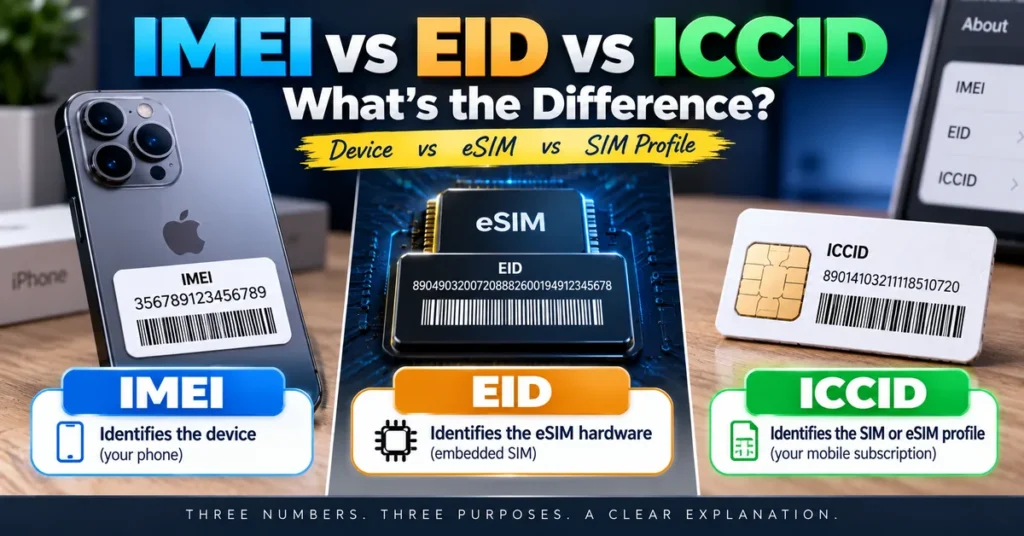
IMEI vs EID vs ICCID can be confusing because all three numbers can appear together in a phone’s settings, especially on modern smartphones with eSIM support. They are not different names for the same identifier, though. Each one points to a different part of the mobile system: IMEI identifies the cellular device, EID identifies the eSIM hardware, and ICCID identifies a SIM or eSIM profile.
That distinction becomes much more useful when you are activating an eSIM, checking a used phone, contacting a carrier, troubleshooting mobile service, or trying to determine which number a particular form is asking for.
Instead of memorizing three long strings of numbers, it helps to understand what each identifier belongs to.
The Short Answer: IMEI, EID and ICCID Identify Different Things
Think of a modern phone as having several layers.
The IMEI belongs to the cellular device.
The EID belongs to the embedded SIM hardware.
The ICCID belongs to the SIM or eSIM profile.
A simple way to remember it is:
IMEI = device
EID = eSIM hardware
ICCID = SIM/eSIM profile
The three identifiers can work together, but they serve different purposes.
| Identifier | What it identifies | Main area |
|---|---|---|
| IMEI | Cellular device/equipment | Phone hardware |
| EID | Embedded UICC/eSIM hardware | eSIM component |
| ICCID | SIM or eSIM profile | Mobile subscription identity |
The GSMA describes IMEI as a unique identifier for a mobile device, while eSIM-related GSMA documentation distinguishes EID from ICCID, with ICCID serving as the profile identifier.
What Is an IMEI?
IMEI stands for International Mobile Equipment Identity.
It is the identifier associated with a cellular device. The standard IMEI is a 15-digit number, and its structure includes information used to identify the device type and individual equipment.
This is the number most closely associated with the phone itself.
For example, when a carrier or device-checking service needs to identify the cellular equipment, the IMEI is usually the relevant identifier.
Our detailed guide on what an IMEI number is explains its purpose and why it matters.
What is an IMEI used for?
An IMEI can be relevant for:
- Identifying cellular equipment
- Carrier device records
- Device support
- Network compatibility
- Lost or stolen device reporting
- Device blacklist checks
- Certain insurance or verification processes
The GSMA also maintains systems used for IMEI and device-status information, including mechanisms through which devices reported lost or stolen can be blocked from cellular networks.
Why can a phone have IMEI and IMEI2?
Modern phones can support multiple cellular interfaces, particularly devices designed for dual-SIM or eSIM configurations.
As a result, you may see:
- IMEI
- IMEI2
These are still device-related identifiers. They should not be confused with ICCID.
If you specifically need the second identifier on an iPhone, our guide on how to find IMEI2 on iPhone covers it separately.
What Is an EID?
EID stands for Embedded Identity Document and is used as the identifier for the embedded UICC, commonly associated with eSIM hardware.
This is where the distinction becomes important.
An EID does not simply identify your phone in the same way an IMEI does. It identifies the embedded SIM component that allows compatible devices to use eSIM technology.
You can think of the EID as belonging to the eSIM hardware layer.
For a deeper explanation, see what an EID number is on a phone.
What is the EID used for?
The EID can be relevant during processes involving:
- eSIM provisioning
- eSIM activation
- Carrier setup
- eSIM troubleshooting
- Device identification during eSIM support
If a carrier asks you for your EID when setting up an eSIM, giving them your IMEI or ICCID instead may not provide the information they need.
Does every phone have an EID?
No.
The EID is associated with devices that contain compatible eSIM hardware. A phone designed only for a traditional removable SIM does not necessarily have an EID.
This is one reason the three identifiers should not be treated as interchangeable.
What Is an ICCID?
ICCID stands for Integrated Circuit Card Identifier.
Unlike IMEI, which identifies the cellular device, ICCID identifies the SIM or an individual eSIM profile.
That makes ICCID much more closely connected to the mobile service profile than to the physical phone.
We have a dedicated guide explaining what an ICCID number is if you want the full explanation.
What is ICCID used for?
You may encounter an ICCID when dealing with:
- SIM activation
- eSIM activation
- SIM replacement
- Carrier support
- SIM identification
- Mobile-service troubleshooting
- eSIM profile management
Apple’s documentation, for example, lists ICCID alongside EID and IMEI as separate identifiers that can be displayed for an iPhone.
Can an eSIM have an ICCID?
Yes.
This is one of the most important points in understanding the difference between EID and ICCID.
An eSIM-capable device can have an EID identifying the eSIM hardware, while an individual eSIM profile can have its own ICCID.
So:
EID → the eSIM hardware
ICCID → the individual SIM/eSIM profile
GSMA documentation explicitly distinguishes the EID from the ICCID used as a unique profile identifier.
IMEI vs EID vs ICCID: The Practical Difference
The easiest way to separate the three is to ask one question:
“What exactly am I trying to identify?”
If the answer is the phone, you are generally dealing with the IMEI.
If the answer is the embedded eSIM hardware, you are dealing with the EID.
If the answer is the SIM or eSIM profile, you are dealing with the ICCID.
This gives you a much more reliable mental model than trying to remember the full names of the identifiers.
IMEI vs EID
IMEI and EID can both appear on an eSIM-capable smartphone, but they identify different components.
IMEI
Identifies the cellular device/equipment.
EID
Identifies the embedded SIM hardware.
For example, imagine you have a new eSIM-capable smartphone.
The phone has an IMEI because it is cellular equipment.
The same phone can have an EID because it contains eSIM hardware.
Those two numbers therefore coexist without representing the same thing.
If you need to locate an EID specifically, see our guides for finding EID on iPhone and finding EID on Android.
IMEI vs ICCID
IMEI and ICCID are perhaps the easiest pair to confuse because both can be requested by carriers.
The difference is straightforward:
IMEI identifies the device.
ICCID identifies the SIM/eSIM profile.
Consider changing the SIM in your phone.
The phone itself has not changed, so its device identity remains associated with the same hardware.
The SIM has changed, however, so the ICCID associated with the active SIM can be different.
This is why an ICCID should not be treated as a second type of IMEI.
EID vs ICCID
EID and ICCID are especially easy to confuse when setting up eSIM service.
Both can appear in the same phone’s information, but they refer to different layers.
EID = embedded eSIM hardware
ICCID = individual SIM/eSIM profile
Think of the EID as identifying the container or hardware environment that supports eSIM profiles, while ICCID identifies a particular profile associated with cellular service.
This distinction becomes useful when a carrier specifically asks for one of these numbers.
If they ask for the EID, do not substitute the ICCID simply because both appear under the phone’s cellular information.
What Happens When You Change SIM Cards?
Changing a SIM is a good real-world example of why IMEI and ICCID are different.
Suppose you have one phone and remove its physical SIM.
You then insert another compatible SIM.
The handset is still the same device.
Its IMEI therefore remains associated with the phone.
The SIM, however, is different.
That means the ICCID associated with the active SIM can also be different.
This relationship is particularly useful when troubleshooting a used phone or comparing multiple SIMs.
What Happens When You Change eSIM Profiles?
The same concept applies to eSIM technology, although the hardware and profile layers are less visible.
An eSIM-capable phone can have:
- A device identifier such as IMEI
- An EID identifying the embedded eSIM hardware
- One or more eSIM profiles
- An ICCID associated with an individual profile
Changing the eSIM profile does not mean that the phone’s EID suddenly becomes a different identifier.
Instead, the active cellular profile can have its own ICCID.
That is why EID and ICCID should always be treated as separate pieces of information.
Where Can You See These Numbers on an iPhone?
Apple makes several of these identifiers available through the iPhone’s information screens.
Go to:
Settings → General → About
Depending on the device and configuration, you may find:
- IMEI
- IMEI2
- EID
- ICCID
- Serial number
Apple specifically lists EID, IMEI/MEID and ICCID among the information that can be found through the iPhone’s About screen.
This is one reason users often assume the numbers are interchangeable: they can literally appear next to each other.
They are not interchangeable.
Where Can You Find Them on Android?
Android device menus vary by manufacturer and software version.
You may find device and SIM-related information under areas such as:
Settings → About phone
or:
Settings → About phone → SIM status
Some manufacturers provide separate SIM, status, or network information screens.
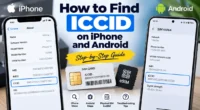
If your goal is specifically to find an ICCID, our guide on how to find ICCID on iPhone and Android explains where to look on both platforms.
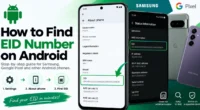
For EID specifically, see how to find EID number on Android.
Which Number Should You Give Your Carrier?
The answer depends entirely on what the carrier is asking for.
If they ask for IMEI
Give the device’s IMEI.
If they ask for EID
Give the EID associated with the eSIM hardware.
If they ask for ICCID
Give the ICCID associated with the SIM or eSIM profile.
Do not assume that a carrier representative can substitute one for another.
The safest approach is to copy the exact identifier requested.
Which Number Matters When Checking a Used Phone?
For a used-phone buyer, the IMEI is usually the most important of these three for checking the device itself.
An IMEI can be used in device-status checks, including blacklist-related checks.
You can use our IMEI Blacklist Checker when you want to investigate whether an IMEI has a reported blocking status.
The ICCID is more relevant to the SIM or cellular profile being used, while EID matters when the device supports eSIM.
So if you are buying a used phone, do not treat a clean ICCID or visible EID as proof that the device’s IMEI is clean.
They answer different questions.
Can an IMEI Lookup Show EID or ICCID?
Not necessarily.
An IMEI lookup focuses on information associated with the device identifier.
EID and ICCID belong to different parts of the cellular identity structure.
That means you should not expect entering an IMEI to automatically reveal the ICCID of whatever SIM happens to be installed in the phone.
Our IMEI lookup tool for iPhone and Android is designed around IMEI-related information rather than treating every mobile identifier as one interchangeable number.
Why Phones Show So Many Different Numbers
Modern smartphones have become more complicated because one device can support multiple cellular configurations.
A single phone may contain or display:
- Serial number
- IMEI
- IMEI2
- EID
- ICCID
- Phone number
- Other network or subscription identifiers
These numbers exist because different parts of the mobile ecosystem need to identify different things.
The mistake is assuming that one identifier should be enough for everything.
It is not.
A carrier provisioning an eSIM, a network identifying a device, and a SIM profile being activated can all need different identifiers.
A Real-World Example
Imagine you purchase an eSIM-capable Android phone.
The phone itself has an IMEI.
Its eSIM hardware has an EID.
You download an eSIM profile from your carrier.
That profile has an ICCID.
Now imagine you delete that profile and install another one.
The phone remains the same.
The eSIM hardware remains the same.
But the cellular profile has changed.
That means the ICCID associated with the active profile can change while the IMEI and EID remain associated with the same hardware.
This single example explains most of the confusion surrounding these three identifiers.
IMEI, EID and ICCID Are Not Security Codes
Another important distinction is that these numbers should not be treated as passwords.
Knowing an IMEI, EID, or ICCID does not by itself prove that someone owns a phone or account.
In fact, IMEI-related technical documentation warns against using an IMEI itself as an authentication credential simply because someone knows the number.
If a website or person asks you to provide one of these identifiers, consider why it is being requested and whether the recipient is trustworthy.
Quick Comparison
| Question | IMEI | EID | ICCID |
|---|---|---|---|
| Identifies the phone? | Yes | No | No |
| Identifies eSIM hardware? | No | Yes | No |
| Identifies a SIM/eSIM profile? | No | No | Yes |
| Associated with device hardware? | Yes | Yes | No |
| Relevant to eSIM setup? | Sometimes | Yes | Yes |
| Can appear in iPhone About? | Yes | Yes | Yes |
| Can be relevant to carrier support? | Yes | Yes | Yes |
| Same thing as the phone number? | No | No | No |
The Easiest Memory Trick
If you regularly forget which number does what, remember this three-part chain:
IMEI → Device
It identifies the cellular equipment.
EID → eSIM hardware
It identifies the embedded SIM hardware.
ICCID → Profile
It identifies the SIM or eSIM profile.
Device → Hardware → Profile
That sequence makes the relationship much easier to remember.
Frequently Asked Questions
Is IMEI the same as ICCID?
No. IMEI identifies the cellular device, while ICCID identifies the SIM or eSIM profile.
Is EID the same as IMEI?
No. EID identifies the embedded eSIM hardware, while IMEI identifies the cellular device.
Is EID the same as ICCID?
No. EID identifies the eSIM hardware, while ICCID identifies an individual SIM or eSIM profile.
Can one phone have an IMEI, EID and ICCID at the same time?
Yes. An eSIM-capable phone can have all three because each identifier belongs to a different part of the mobile system.
Can ICCID change while IMEI stays the same?
Yes. Replacing a SIM or changing an eSIM profile can result in a different ICCID while the phone remains the same device.
Can EID change when I change eSIM profiles?
The EID is associated with the embedded eSIM hardware, while individual profiles have their own ICCIDs. Changing the profile should therefore not be confused with changing the EID.
Which number should I use for a blacklist check?
For a phone blacklist check, the relevant identifier is the IMEI, not the ICCID or EID.
Which number is needed for eSIM activation?
It depends on the carrier and activation process. Some processes may request the EID, while others may use information associated with the eSIM profile. Always provide the specific identifier requested by the carrier.
Final Takeaway
The confusion around IMEI, EID and ICCID disappears once you stop treating them as variations of the same number.
They identify different layers of a mobile device:
IMEI identifies the cellular device.
EID identifies the embedded eSIM hardware.
ICCID identifies the SIM or eSIM profile.
A modern smartphone can contain all three at once, and they can appear next to each other in the same settings screen. That does not make them interchangeable.
If you remember only one thing, remember this:
IMEI = phone. EID = eSIM hardware. ICCID = SIM/eSIM profile.
That distinction is enough to help you choose the right identifier when activating service, troubleshooting connectivity, checking a used device, or communicating with a carrier.