
What Is a TAC Number? How TAC Identifies a Phone
What is a TAC number? A TAC number, or Type Allocation Code, is the first eight digits of an IMEI and is used to identify the type of mobile device associated with that IMEI. While the complete IMEI distinguishes an individual phone, the TAC points toward the device model, brand owner, and other model-level information registered within the mobile-device identification system.
That distinction is easy to miss because most people see an IMEI as one 15-digit number. In reality, an IMEI has a structure, and the TAC is the part that tells the mobile ecosystem what kind of device the identifier belongs to.
Understanding TAC is useful when you are researching a phone model, examining an IMEI, comparing device identifiers, or trying to understand how networks can recognize different types of mobile equipment.
TAC Meaning: What Does TAC Stand For?
TAC stands for Type Allocation Code.
It is an eight-digit code assigned within the global IMEI allocation system. The TAC is associated with a particular device type or model and forms the beginning of the device’s IMEI.
For example, a simplified IMEI can be represented like this:
12345678 123456 7
The structure is:
- 12345678 → TAC
- 123456 → individual device serial number
- 7 → check digit
The numbers above are only an example of the structure and are not intended to represent a real device.
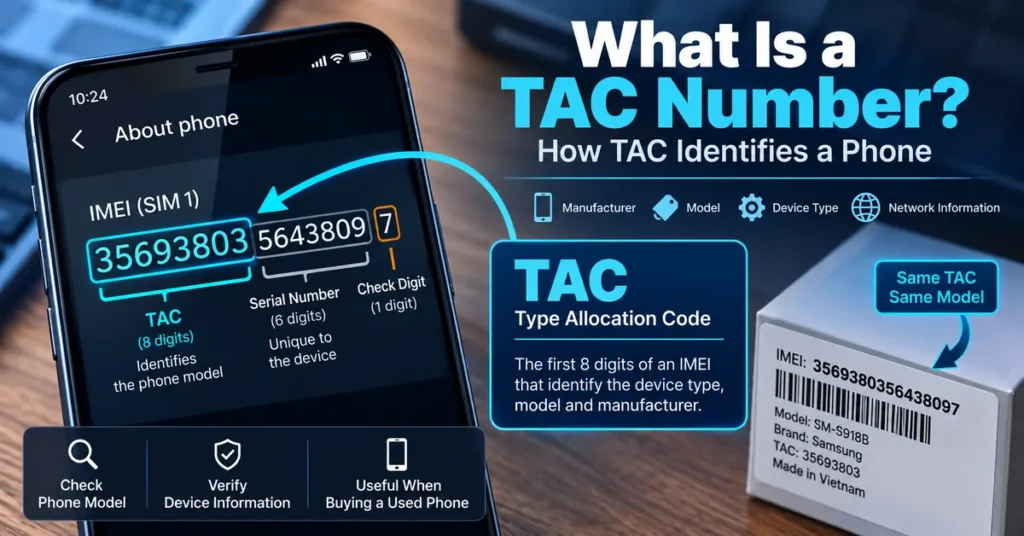
The important idea is that the TAC is not the entire IMEI.
It is one component of the IMEI.
TAC vs IMEI: What Is the Difference?
This is the most important distinction to understand.
An IMEI identifies an individual mobile device, while the TAC identifies the device type or model represented by the first eight digits of that IMEI.
Think of it this way:
TAC = Which type of device is this?
IMEI = Which individual device is this?
Two phones of the same model can therefore share the same TAC while having different complete IMEI numbers.
For example:
| Identifier | What it tells you |
|---|---|
| TAC | Device type/model information |
| IMEI | Individual mobile device identity |
| Serial number | Manufacturer-specific device identifier |
| Phone number | Mobile service/subscriber number |
| SIM identifier | SIM/subscription identity |
This is why you cannot use a TAC as a replacement for an IMEI when a carrier or checking service asks for the complete device identifier.
Where Is the TAC Number on an IMEI?
The TAC is located at the beginning of the IMEI.
For a standard 15-digit IMEI:
Digits 1–8 = TAC
Digits 9–14 = individual device serial number within that TAC
Digit 15 = check digit
The exact technical representation has evolved through mobile standards, but this 8 + 6 + 1 structure is the familiar format used when explaining a standard IMEI.
So if an IMEI were:
35678901 123456 4
the TAC would be:
35678901
The remaining digits are not part of the TAC.
Why Does a Phone Need a TAC?
A cellular network needs to know more than the subscriber’s phone number.
It also needs to recognize the equipment connecting to the network.
The TAC provides a standardized way of associating the beginning of an IMEI with a particular device type.
This can help the mobile ecosystem understand characteristics associated with the device, including its manufacturer and model information.
The GSMA explains that TAC is used to identify the device model type or marketing name and is allocated to a specific manufacturer and device model.
That makes TAC particularly useful behind the scenes.
A phone may simply show you a model name such as “Galaxy S-series” or “iPhone,” but network and industry systems work with structured identifiers rather than relying only on the name printed on the box.
Who Assigns a TAC?
TACs are part of the global IMEI allocation system managed through the GSMA and its authorized processes.
Device manufacturers or brand owners apply for TAC allocation for their device types.
The TAC is then used as the starting component when creating IMEIs for individual devices of that type.
This is important because a manufacturer does not simply invent an arbitrary eight-digit TAC and start using it.
TAC allocation follows rules designed to maintain uniqueness and prevent duplication within the global device-identification system.
Does Every Phone Model Have Its Own TAC?
A device model is generally associated with its allocated TAC, but the relationship is not as simple as saying that every version of a commercial phone name always has exactly one TAC.
Different TACs can be allocated for legitimate reasons, including different device variants or production requirements.
GSMA allocation rules are designed around the device model and the allocation of IMEI ranges rather than simply the marketing name consumers see on a store shelf.
This is why two phones that appear almost identical to a consumer can sometimes have different TAC information.
Can Two Phones Have the Same TAC?
Yes.
In fact, this is completely normal.
The TAC identifies the device type, not each individual physical handset.
Imagine a manufacturer produces 500,000 units of the same device model.
Those phones can use the same TAC while receiving different individual IMEIs.
For example:
Phone A
TAC: 12345678
IMEI: 123456781234567
Phone B
TAC: 12345678
IMEI: 123456781234575
The TAC is the same because the devices belong to the same allocated device type.
The complete IMEIs are different because they identify different physical devices.
Can Two Different Phone Models Have the Same TAC?
A TAC is intended to identify a specific device type/model, so it should not be treated as a generic manufacturer code that applies to every phone from a brand.
A manufacturer does not receive one universal TAC and use it for every smartphone it produces.
The allocation system is designed so that TAC information distinguishes device types.
If a device model changes in a way that requires a new allocation under the applicable rules, a different TAC may be used.
This is one reason TAC information can be more useful than simply looking at the brand name.
TAC Is Not the Same as a Phone’s Serial Number
This is another common misunderstanding.
A TAC is not the same as the manufacturer’s serial number.
They serve different purposes.
TAC
The TAC is part of the IMEI structure and identifies the device type/model.
Device Serial Number
The manufacturer’s serial number is assigned by the manufacturer for its own device identification and service systems.
IMEI Serial Number Component
The six digits following the TAC are the serial-number portion of the IMEI structure.
That last point causes considerable confusion because the phrase “serial number” can refer to different identification systems.
A phone can therefore have:
- A TAC
- A complete IMEI
- A manufacturer serial number
- A model number
These should not be treated as interchangeable.
If you want to understand the difference between IMEI and manufacturer serial numbers on an iPhone, see our guide on how to check the serial number of an Apple iPhone.
TAC vs IMEI: A Simple Example
Suppose a phone has this IMEI:
49015420 123456 8
Break it into three sections:
49015420 | 123456 | 8
The first eight digits:
49015420
are the TAC.
The next six digits:
123456
represent the individual device’s serial-number portion within that TAC.
The final digit:
8
is the check digit.
The complete 15-digit number identifies the individual device.
The first eight digits tell you about the device type associated with that IMEI.
This is why removing the final seven digits from an IMEI does not give you another complete device identifier. It gives you the TAC.
What Information Can a TAC Tell You?
A TAC can be associated with information about the device type registered for that code.
Depending on the database being used, TAC-related information may include details such as:
- Manufacturer or brand owner
- Device model
- Device type
- Marketing name
- Certain technical attributes
- Device capabilities recorded in the relevant database
However, a TAC is not a complete phone report.
The amount of information available depends on the database and service performing the lookup.
You should therefore be cautious with websites claiming that every TAC can automatically reveal every detail about a phone.
Can You Identify a Phone Model From the TAC?
In many cases, TAC information can be used to associate an IMEI with the device model or type for which that TAC was allocated.
This is one of the main reasons TAC exists.
However, the result depends on the quality and coverage of the database being used.
A TAC lookup may identify a device family or model information, but that does not mean it will automatically reveal:
- The owner
- The phone number
- The current location
- The complete purchase history
- Whether the phone is physically damaged
- Whether the device is currently active
- Every carrier restriction
TAC is model-level identification, not a complete personal or device-history report.
TAC Lookup vs IMEI Lookup
These two searches can overlap, but they answer different questions.
TAC Lookup
A TAC lookup focuses on the first eight digits and attempts to determine what device type or model is associated with that TAC.
IMEI Lookup
An IMEI lookup uses the complete device identifier and may provide broader information depending on the service and database.
A simple way to think about it is:
TAC lookup → What type of device is this identifier associated with?
IMEI lookup → What information can be found about this particular device identifier?
If you are researching a phone you own or are considering buying, start with the complete IMEI rather than extracting the TAC unless you specifically need model-level information.
Our IMEI Lookup Tool is designed around the broader IMEI lookup intent.
Does TAC Identify the Exact Phone?
No.
This distinction is critical.
The TAC does not uniquely identify your individual handset.
Instead, it identifies the device type associated with the beginning of the IMEI.
Imagine 100,000 identical phones leaving the same factory.
They can share the same TAC.
They cannot legitimately share the same complete IMEI.
The TAC tells you about the class of device.
The complete IMEI distinguishes the individual device.
Can a TAC Tell You if a Phone Is Blacklisted?
No.
A TAC by itself is not a blacklist status.
A blacklist investigation is concerned with the device’s relevant identifier and the databases used to determine whether that device has been reported or restricted.
Because many phones of the same model can share one TAC, a TAC cannot tell you whether your particular handset has been reported.
For example:
Phone A
TAC: 12345678
IMEI: 123456781111116
Status: potentially restricted
Phone B
TAC: 12345678
IMEI: 123456782222224
Status: clean
The TAC is identical because the phones are the same device type.
The device status can still be completely different.
If you are checking a used phone, use the complete IMEI for the relevant investigation. Our IMEI Blacklist Checker is more appropriate for blacklist-related searches.
Can TAC Identify a Stolen Phone?
Not by itself.
A TAC can help identify the device type, but it does not uniquely identify an individual stolen handset.
If a phone is reported lost or stolen, the relevant investigation is based on the complete device identifier and the applicable carrier or device-status databases.
This distinction matters because thousands or even millions of devices can potentially belong to the same model family.
A TAC cannot tell you which physical handset is yours.
Does TAC Change When You Change the SIM Card?
No.
The TAC is part of the device’s IMEI structure.
Changing the SIM card does not normally change the phone’s TAC.
You could move a SIM between two compatible phones and the subscriber information would change with the SIM, but the devices themselves would retain their own equipment identifiers.
This is another reason to keep these concepts separate:
SIM → subscription
Phone number → mobile service
IMEI → individual device
TAC → device type/model portion of the IMEI
Does a Factory Reset Change the TAC?
A normal factory reset is not intended to change the TAC.
The TAC is part of the device’s IMEI structure and is associated with the device identification assigned through the manufacturer’s and GSMA allocation processes.
A factory reset normally removes user data and restores software settings; it is not a mechanism for assigning a new device model identifier.
If an IMEI-related problem appears after a reset or firmware operation, that is a different troubleshooting question.
Our IMEI Repair Tool guide covers the broader issue of missing, invalid, or damaged IMEI information.
Does TAC Change With a Software Update?
Normally, no.
A routine operating-system or firmware update does not mean that the device suddenly becomes a different model.
The TAC is tied to the device type and its allocated IMEI range.
However, it is important to distinguish the IMEI from IMEI Software Version (IMEISV) information.
An IMEISV can include a software-version component, whereas the TAC itself remains the model/type component at the beginning of the identifier.
So an update can affect software-version information without turning the TAC into a new model identifier.
What Is the Relationship Between TAC and IMEISV?
IMEISV stands for International Mobile Equipment Identity and Software Version.
It uses the TAC and device serial-number portion but includes a software-version number instead of the normal IMEI check-digit structure.
This is useful when you are studying the technical structure of mobile-device identifiers.
The simplified distinction is:
IMEI
TAC + device serial portion + check digit
IMEISV
TAC + device serial portion + software version
The TAC remains the first eight digits.
For most everyday phone buyers, you will not need to work directly with IMEISV information. But it explains why the first eight digits remain important even when software-version identification is involved.
Why TAC Matters to Mobile Networks
TAC is not just a number created for databases.
It is part of the infrastructure that helps the mobile industry identify equipment types.
A network can use device identification information to understand what kind of equipment is connecting and apply device-related policies or configurations where appropriate.
The GSMA notes that TAC information can help network operators determine device types and associated capabilities.
This becomes especially important in a mobile environment containing:
- Smartphones
- Tablets
- Cellular modems
- Wearables
- IoT devices
- Connected vehicles
- Other cellular equipment
TAC is therefore not limited to smartphones.
Is TAC Only Used for Smartphones?
No.
The TAC system applies to a much wider range of cellular equipment.
GSMA materials describe TAC/IMEI requirements across 3GPP-compatible equipment types, including devices such as IoT equipment, modems, and other connected products.
That means a cellular-connected device can have an IMEI structure even if it does not look anything like a traditional smartphone.
For example, a cellular modem or connected device can still need a device identity that the network can recognize.
Can You Calculate the TAC From an IMEI?
Yes.
If you have a standard 15-digit IMEI, the TAC is simply the first eight digits.
For example:
IMEI: 35824011 654321 2
TAC: 35824011
There is no mathematical conversion required.
You simply separate the first eight digits from the rest.
The difficult part is not extracting the TAC.
The difficult part is correctly interpreting what that TAC represents and finding reliable information associated with it.
Can You Create an IMEI From a TAC?
Not by itself.
Having a TAC does not give you a complete IMEI.
The remaining digits are required to create the full identifier, and the allocation and construction of IMEIs are governed by specific rules.
A TAC is therefore better understood as an allocated starting block for device identities, not as a complete IMEI.
You cannot take a TAC and assume that any random sequence of additional digits will produce a legitimate device identifier.
GSMA rules exist specifically to maintain uniqueness, allocation control, and security within the IMEI system.
Does Every IMEI Have a TAC?
For standard IMEI structures used by compatible cellular equipment, the TAC forms the first eight digits.
This is one of the defining structural elements of the IMEI.
If you have what appears to be a 15-digit IMEI, the first eight digits are the portion you would examine when determining the TAC.
If the number is malformed, incomplete, or not actually an IMEI, however, extracting eight digits does not magically make them a valid TAC.
The complete identifier still needs to be valid.
TAC and Dual-SIM Phones
Dual-SIM phones introduce another detail that can confuse people.
A device with multiple cellular transceivers can have multiple IMEIs.
That means you may see:
IMEI 1
and
IMEI 2
on the same phone.
Each IMEI has its own identifier structure and therefore its own TAC component.
In practical terms, do not assume that every IMEI displayed by a multi-SIM phone must be identical.
The relevant device architecture determines how the identifiers are assigned.
GSMA’s IMEI rules specifically address multi-SIM and multi-transceiver equipment.
TAC and Used Phone Buying
TAC can be useful when buying a second-hand phone, but it should not be your only check.
Suppose a seller advertises a phone as a particular model.
You can inspect the device’s IMEI and examine its TAC-related information to see whether the identifier corresponds to the claimed device type.
If the information does not make sense, stop and investigate before paying.
For example, if:
- The seller claims it is Model A
- The phone’s settings identify Model A
- The packaging identifies Model A
- But the available TAC information points toward a different device type
that discrepancy deserves investigation.
It does not automatically prove that the phone is stolen or counterfeit, but it is a reason to verify the device more carefully.
Can TAC Help Detect a Counterfeit Phone?
It can sometimes provide a useful clue, but TAC should not be treated as a standalone counterfeit detector.
A counterfeit or incorrectly identified device may present inconsistent model and identifier information.
Comparing:
- Device model
- IMEI
- TAC
- Manufacturer serial number
- Software information
- Physical hardware
- Packaging
- Carrier compatibility
can reveal inconsistencies.
However, sophisticated counterfeit devices can also present copied or manipulated information.
TAC is therefore best viewed as one verification signal among several, not a definitive authenticity test.
TAC vs Model Number
A TAC and a manufacturer’s model number are also different.
A model number is a manufacturer-defined product identifier.
A TAC is part of the standardized IMEI identification system.
The two may both point toward the same general device model, but they are not interchangeable.
For example:
Manufacturer model number: a product code used by the manufacturer
TAC: the eight-digit IMEI component allocated to the device type
IMEI: the complete individual equipment identifier
Using all three together can give you a clearer picture of what device you actually have.
Why TAC Information Can Be Different Across Databases
You may occasionally find different descriptions when searching the same TAC on different websites.
There are several possible reasons.
A database may:
- Use a different source
- Have older information
- Display a marketing name differently
- Group regional variants differently
- Have incomplete records
- Use manufacturer or brand-owner information differently
Therefore, do not automatically assume that the first TAC lookup result on the internet is definitive.
For important device investigations, compare the TAC information with the phone itself and use reliable sources.
TAC Number FAQs
What is a TAC number?
A TAC number is an eight-digit Type Allocation Code forming the first eight digits of an IMEI. It identifies the device type or model associated with that IMEI.
What does TAC stand for?
TAC stands for Type Allocation Code.
How many digits does a TAC have?
A TAC has eight digits.
Where is the TAC located in an IMEI?
The TAC is the first eight digits of a standard IMEI.
Is TAC the same as IMEI?
No. TAC is only the first eight digits of the IMEI. The complete IMEI identifies an individual device.
Can two phones have the same TAC?
Yes. Phones of the same allocated device type can share the same TAC while having different complete IMEIs.
Can two phones have the same IMEI?
Legitimate individual devices should have unique IMEIs. Duplicate IMEIs are a serious device-identity problem.
Can TAC identify my exact phone?
No. TAC identifies the device type/model associated with the IMEI. It does not uniquely identify your individual physical handset.
Can TAC tell me if a phone is blacklisted?
No. A TAC identifies the device type, while blacklist investigations concern the relevant complete device identifier and applicable databases.
Can I find the TAC without the full IMEI?
Yes, if you have the beginning of the IMEI. The TAC is the first eight digits.
Does a SIM card have a TAC?
No. TAC is associated with the mobile equipment identifier, not the SIM subscription.
Does changing the SIM change the TAC?
No. Changing the SIM does not normally change the TAC associated with the phone’s IMEI.
Does a factory reset change the TAC?
A normal factory reset is not designed to change the device’s TAC or assign a new IMEI.
Does the TAC reveal the phone owner?
No. TAC is device-model information, not personal ownership information.
Is TAC useful when buying a used phone?
Yes, as one verification step. It can help you compare the device type associated with the IMEI against the model claimed by the seller.
Is TAC used only for iPhones and Android phones?
No. TAC/IMEI identification is used across many types of cellular equipment, including modems, IoT devices, and other connected products.
Final Thoughts
A TAC number is easy to overlook because it is hidden inside something most people simply call an IMEI.
But those first eight digits have a specific job.
TAC identifies the device type.
The remaining IMEI information distinguishes the individual device.
That difference explains why several phones can have the same TAC while still having completely different IMEI numbers.
For everyday users, the most practical use of TAC is verification. If you are researching a used phone, you can compare the device’s IMEI-related information with the model claimed by the seller. If you are investigating an unfamiliar device, TAC can help establish what type of equipment the identifier belongs to.
But TAC is not a substitute for a complete IMEI check.
It cannot tell you whether your particular phone is blacklisted, whether it is carrier locked, who owns it, or whether the hardware is genuine.
For those questions, you need the appropriate device information and the appropriate checking method.
If you want broader information associated with a phone’s complete identifier, use our IMEI Lookup Tool. If you are specifically investigating whether a used phone may have a reported or restricted status, use our IMEI Blacklist Checker.
And if the IMEI itself is missing, invalid, or no longer appearing correctly on the phone, that is a different problem altogether. In that situation, our IMEI Repair Tool guide is the more relevant resource.
Once you understand the structure, the concept is simple:
TAC tells you what type of device the IMEI belongs to. The complete IMEI tells the network which individual device it is.