How to Find a Samsung Phone That Is Lost by IMEI Number
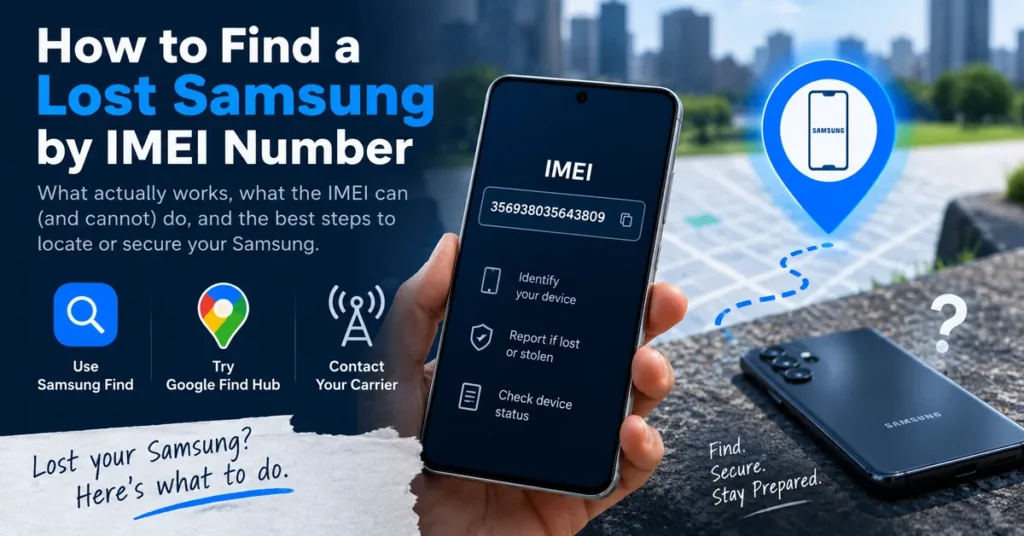
How to find my Samsung phone that is lost by IMEI number is a question many people ask after realizing that their Galaxy device is no longer with them. The important thing to understand first is that an IMEI number does not work like a GPS tracker. It identifies the physical device, while Samsung Find and Google Find Hub are the services designed to locate a lost phone on a map.
If you still have your Samsung’s IMEI number, however, you should keep it available. It can become extremely useful when you need to identify the device, report it to your carrier, provide information to authorities, or verify the phone later.
Can You Find a Samsung Phone Directly With Its IMEI?
Not in the way many websites claim.
Entering a Samsung IMEI into a random online “IMEI tracker” does not give an ordinary user access to the phone’s live GPS position. The IMEI is a device identifier, not a public location service.
That distinction matters because many people lose valuable time searching for an “IMEI tracking website” when their Samsung can potentially be located through the accounts and services that were already connected to the phone.
If the phone is still connected to your Samsung account or Google account, those services should be your first choice.
The IMEI becomes particularly important if the phone cannot be located, has been stolen, or needs to be reported to your carrier.
1. Try Samsung Find First
For a Samsung Galaxy device, Samsung’s own finding system should be one of the first places you check.
Samsung currently provides Samsung Find and SmartThings Find for locating compatible Galaxy phones and tablets. Depending on your device, software version and setup, you can use the service from another Galaxy device or through its website.
Open Samsung’s finding service and sign in with the Samsung account that was connected to the lost phone.
Once the device appears in your account, you may be able to see its location and use remote functions such as:
- Ring the phone
- Lock the device
- Track its location
- Display information for someone who finds it
- Erase the device when recovery is no longer realistic
Samsung says the phone generally needs to be powered on and connected to a network for location features, while certain offline-finding capabilities depend on the relevant settings being enabled beforehand.
What if the Samsung is offline?
Do not immediately assume that the phone is gone permanently.
Samsung’s offline-finding feature can help compatible devices be detected through nearby Galaxy devices when the feature was enabled before the phone went missing. The available options depend on the device and its settings.
This is one reason why preparing the phone for loss before something happens is far more effective than searching for an IMEI tracker afterward.
2. Use Google Find Hub on Your Samsung
Your Samsung Galaxy is also an Android device, so Google Find Hub can be another important recovery option.
Google’s current Find Hub service can locate, secure or erase a compatible lost Android device. If the phone is associated with your Google Account and the required settings were enabled, you can access Find Hub from another device or a web browser.
Go to:
android.com/find
Sign in with the Google Account that was used on the missing Samsung.
Select your Galaxy from the available devices.
Depending on the phone’s condition and configuration, Find Hub can show its current or recent location and can provide options such as playing a sound, marking the phone as lost, securing it, or erasing it.
Google also states that the device may be unavailable for location if it has no power, has lost mobile/Wi-Fi connectivity, has been damaged, or has other conditions preventing location detection.
3. Use the IMEI Number When the Phone Cannot Be Located
This is where your IMEI number becomes particularly valuable.
Suppose Samsung Find and Google Find Hub cannot show you where the phone is. You should not conclude that the IMEI can now be entered into a website to reveal its position.
Instead, use the IMEI as the device identifier when dealing with the organizations that can actually assist with a lost or stolen phone.
Depending on your situation, that may include:
- Your mobile carrier
- The police or relevant authorities
- Your insurance provider
- The retailer or seller
- Samsung support
- Another organization handling the loss or theft report
Give them the correct IMEI rather than guessing or entering a different number.
If you previously recorded the IMEI from the phone’s packaging, purchase documentation, account information or another legitimate source, keep that information with your report.
4. Check the IMEI Before Buying a Replacement or Used Samsung
Losing a phone often creates another problem: replacing it quickly.
If you decide to purchase a used Samsung because you need a replacement, do not simply check whether the device turns on.
The IMEI can help you investigate the device’s status before paying.
Our IMEI Blacklist Checker can be useful when you want to investigate whether a device may have been reported or restricted.
A blacklist check is not the same as locating a phone, and a clean result does not prove that a used device is problem-free. You should also verify ownership, activation status, carrier compatibility, physical condition and other relevant details.
For broader device information, you can also use our IMEI Lookup Tool.
5. What the IMEI Can Actually Tell You
The IMEI is valuable because it identifies the mobile device itself.
It is different from:
- Your phone number
- Your SIM card
- Your Samsung account
- Your Google account
- Your device’s GPS location
For example, if you have two Samsung phones, each device has its own IMEI even if both are using the same mobile carrier.
That is why a carrier can use an IMEI when dealing with a lost or stolen device.
If you want to understand the broader role of an IMEI, our IMEI Number Check Online resources can help you distinguish device identification from location tracking.
6. If You Think the Samsung Was Stolen
Treat a suspected theft differently from a phone that was simply misplaced.
If Samsung Find or Google Find Hub displays a location that appears to be somewhere unfamiliar, do not go to that location yourself.
Samsung specifically advises users not to directly visit the mapped location of a stolen device and instead to contact the authorities.
Instead:
- Mark the phone as lost or secure it remotely.
- Record the displayed location and relevant information.
- Contact your mobile carrier.
- Report the theft to the appropriate authorities.
- Provide the phone’s IMEI.
- Keep your purchase receipt or other ownership documentation.
- Change important account passwords if you believe the phone or accounts may be compromised.
The IMEI is particularly useful here because it gives the report a specific identifier for the physical device.
7. Can a Carrier Track a Samsung Using the IMEI?
A carrier can use an IMEI as part of its device-management processes, including identifying or disabling a device in appropriate circumstances.
That does not mean that a consumer can enter the IMEI into a public website and see the phone moving around on a map.
This distinction is often missing from low-quality “IMEI tracker” articles.
Your carrier may have information or procedures that are not available to the general public. If the phone has been lost or stolen, contact the carrier as soon as possible and provide the correct IMEI.
Google also notes that a mobile service provider may use the device’s IMEI when disabling a lost Android device.
8. What If You Never Saved the IMEI?
You may still be able to recover it.
Google says that the IMEI of an Android device can be viewed through Find Hub by selecting the device and opening its settings.
You may also find the IMEI on:
- The original Samsung box
- Purchase documentation
- A carrier account or device record
- A previous repair document
- Device records associated with your accounts
For future protection, it is a good idea to record the IMEI somewhere safe before a phone is lost.
You can normally find an IMEI on a working Samsung through the phone’s settings or by using the appropriate device information screen.
9. What If Samsung Find Shows No Location?
There are several possible explanations.
The phone may:
- Be switched off
- Have a dead battery
- Have no usable network connection
- Have been damaged
- Be in an area with poor connectivity
- Have had location or finding features disabled
- Have lost access to the account required for the service
- Be unavailable for another device-specific reason
Google specifically lists lack of power, lack of mobile/Wi-Fi connectivity, damage and certain connection conditions among situations where Find Hub may be unable to locate a device.
Samsung similarly states that its finding services depend on device and account requirements, while offline finding can provide additional possibilities when it was configured beforehand.
Therefore, “no location available” does not mean that the IMEI is useless. It simply means that the location service does not currently have a usable location to display.
10. Don’t Confuse IMEI Tracking With IMEI Checking
These are three different activities:
IMEI tracking
Trying to locate a device.
IMEI checking
Investigating information or status associated with the device identifier.
IMEI reporting
Providing the device identifier to a carrier, authority or other relevant organization after loss or theft.
The distinction is important throughout the recovery process.
If you want to investigate a phone’s reported or restricted status, use our IMEI Blacklist Checker.
If you want broader IMEI information, use our IMEI Lookup Tool.
If the device itself has an IMEI problem rather than a lost-phone problem, our IMEI Repair Tool covers a completely different situation involving missing, invalid or corrupted device-identification information.
11. What You Should Do Immediately After Losing a Samsung
The order of your actions can make a difference.
First: Try Samsung Find
Sign in to the Samsung account associated with the missing Galaxy and check whether the device is visible.
Second: Try Google Find Hub
Go to android.com/find and sign in with the associated Google Account.
Third: Secure the Phone
If the phone is outside your immediate surroundings, use the available lock or lost-device options.
Fourth: Contact Your Carrier
Tell the carrier that the Samsung is lost or stolen and provide the IMEI.
Fifth: Report the Device if Necessary
If you believe the phone was stolen, make a proper report and provide the IMEI and proof of ownership where required.
Sixth: Protect Your Accounts
If you believe somebody may have access to your device, review your important accounts and change credentials where appropriate.
Seventh: Erase the Phone Only When Appropriate
Remote erasure can protect personal information, but it can also affect your ability to continue locating the device. Google specifically warns that after an Android device is erased, it will no longer be available in Find Hub.
Think carefully before using the erase option if there is still a realistic chance of recovering the phone.
Updated: September 8, 2026
Frequently Asked Questions
Can I find my Samsung phone using only its IMEI number?
No. An IMEI number by itself does not provide consumers with a live GPS location. Use Samsung Find or Google Find Hub to attempt to locate the phone, and use the IMEI when reporting or identifying the missing device.
Is there a free IMEI tracker that shows my Samsung on a map?
Be very cautious with websites making this claim. A normal public IMEI lookup does not provide access to a phone’s live GPS position. Samsung Find and Google Find Hub are the appropriate services to try first.
Should I give my IMEI to my mobile carrier?
Yes, when reporting a lost or stolen phone, the IMEI can help the carrier identify the specific device.
Can someone track my Samsung just because they know the IMEI?
Knowing an IMEI does not give an ordinary person access to the phone’s live location. Location services and account-based device-finding systems are separate from the IMEI itself.
What should I do if my Samsung was stolen?
Try Samsung Find and Google Find Hub, secure the device remotely, contact your carrier, report the theft to the appropriate authorities and provide the IMEI and ownership information.
Do not personally travel to a suspected thief’s location simply because a map shows the device there.
Can I track a Samsung after the SIM card is removed?
It depends on the finding system, device configuration, connectivity and whether offline-finding features were enabled. Removing a SIM does not turn the IMEI into a tracking mechanism.
Can an IMEI blacklist check find my lost Samsung?
No. A blacklist check investigates the status of an IMEI. It does not provide the phone’s live location.
What is the best way to find a lost Samsung?
For a compatible Galaxy device, start with Samsung Find or SmartThings Find. Also check Google Find Hub because the phone is an Android device. Keep the IMEI available for reporting, carrier assistance and device identification.
Final Answer: Use the IMEI for Identification, Not as a GPS Tracker
If you are trying to find a Samsung phone that is lost by IMEI number, the most important thing to remember is that the IMEI and the location service perform different jobs.
The IMEI identifies the device.
Samsung Find and Google Find Hub are designed to help locate it.
If your Galaxy is missing, start with the Samsung account and Google account that were already connected to the phone. Check the available location, ring or secure the device when possible, and use remote erasure only when you have decided that protecting the data is more important than continuing recovery attempts.
If those services cannot locate the phone, do not waste time entering the IMEI into questionable tracking websites. Keep the IMEI and use it when dealing with your carrier, authorities, insurance provider or other legitimate organization handling the lost or stolen device.
And if you are checking another Samsung before buying it, use an IMEI Blacklist Checker rather than confusing a device-status check with a location service.
The practical rule is simple:
Use Samsung Find or Google Find Hub to look for the phone. Use the IMEI to identify and report the phone.