IMEI vs MEID: What Is the Difference?
IMEI vs MEID is a comparison that usually comes up when someone finds an unfamiliar device identifier on an older smartphone, especially a phone associated with CDMA networks. Although both numbers identify cellular equipment, they come from different mobile-network identification systems and are not simply two names for the same number. Understanding the difference can help you recognize the identifier on a phone, choose the right type of device check, and avoid entering the wrong number into an IMEI tool.
The simplest way to think about it is this: IMEI is the device identifier most commonly associated with GSM-family cellular technology, while MEID was designed for CDMA2000 equipment. Modern phones and networks have changed considerably, so the distinction is more historical and technical than it may appear at first.
Why Do Phones Have These Identifiers?
A cellular network needs a way to distinguish the physical equipment connecting to it.
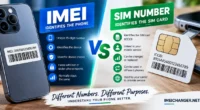
Your phone number identifies the mobile service. Your SIM or eSIM identifies the subscriber-side credentials used for network access. The device identifier belongs to the hardware itself.
That is where identifiers such as IMEI and MEID come into the picture.
They allow cellular systems and related databases to associate network activity with a particular piece of mobile equipment.
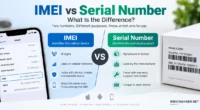
This is also why an IMEI or MEID should not be confused with the manufacturer’s ordinary serial number. These identifiers can serve different technical and operational purposes even though they all appear in information screens, packaging, repair records, or device databases.
IMEI and MEID Were Built Around Different Network Technologies
The historical difference becomes much easier to understand when you look at the mobile technologies behind the numbers.
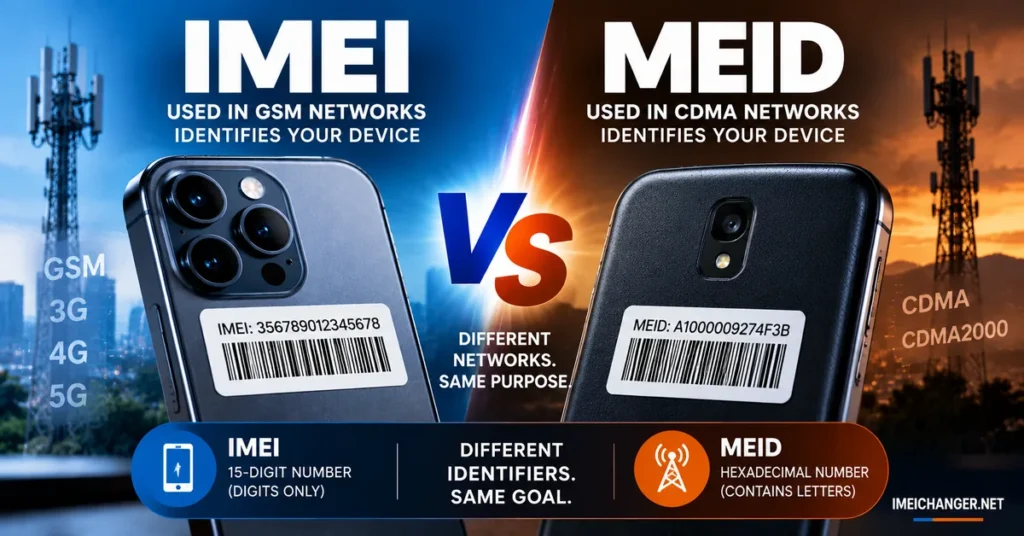
IMEI stands for International Mobile Equipment Identity. It is the standard equipment identifier used in GSM-family cellular environments and is now widely associated with 3G, 4G LTE, and modern cellular devices.
MEID stands for Mobile Equipment Identifier. It was developed for CDMA2000 cellular equipment and became an important replacement for older ESN-based identification as CDMA device populations grew.
So the difference is not simply:
IMEI = one type of number
MEID = another type of number
The deeper distinction is that they originated from different cellular technology ecosystems and numbering standards.
That history explains why MEID is much more likely to appear when you are dealing with an older CDMA phone than when you are checking a current mainstream smartphone.
What Does an IMEI Look Like?
A standard IMEI is a 15-digit decimal identifier.
For example, an IMEI may look like:
356789012345678
The number is made entirely from digits from 0 through 9.
The IMEI structure contains information used to identify the device type and individual unit. The first portion is the Type Allocation Code (TAC), followed by an individual serial portion and a check digit.
This structure is one reason an IMEI can be useful when identifying a phone through an IMEI lookup.
If you have an IMEI and want to investigate the information associated with it, you can use the IMEI Lookup Tool for Android and iPhone.
What Does a MEID Look Like?
MEID can look quite different.
A hexadecimal MEID uses characters from:
0–9 and A–F
For example:
A1000009274F3B
That appearance can immediately tell you that you are probably not looking at a conventional 15-digit IMEI.
MEID was designed around a 56-bit identifier and is commonly represented using hexadecimal characters. Technical documentation can describe the MEID representation in slightly different ways depending on whether the check digit or a particular encoded representation is being discussed, which is one reason you may encounter apparently different digit counts when researching MEID.
For everyday phone identification, the important clue is simpler:
An MEID may contain hexadecimal letters, while a conventional IMEI is a 15-digit decimal number.
IMEI vs MEID at a Glance
| Identifier | Full Name | Historical Network Association | Typical Format | Main Purpose |
|---|---|---|---|---|
| IMEI | International Mobile Equipment Identity | GSM / 3GPP cellular systems | 15 decimal digits | Identifies cellular equipment |
| MEID | Mobile Equipment Identifier | CDMA2000 / 3GPP2 systems | Hexadecimal representation | Identifies cellular equipment |
| ESN | Electronic Serial Number | Older CDMA systems | Numeric identifier | Earlier CDMA equipment identification |
The important point is that IMEI and MEID both identify mobile equipment, but they belong to different identifier systems.
MEID Replaced Older ESN Identification on CDMA Devices
One reason MEID appears in discussions about older phones is its relationship with the ESN, or Electronic Serial Number.
Early CDMA equipment relied heavily on ESNs. As the available ESN space became insufficient for the growing number of devices, MEID was introduced as a larger identifier.
This makes MEID part of an evolutionary chain:
Older CDMA phones → ESN → MEID
Meanwhile, the GSM ecosystem used IMEI as its equipment identity system.
That history is useful when examining older phones because a device may contain references to more than one identifier depending on its technology and compatibility.
Can a Phone Have Both an IMEI and a MEID?
This is where the comparison gets more interesting.
Some devices designed around multiple cellular technologies can have identifiers associated with different network systems. A phone built to operate across different radio technologies may therefore present information that does not fit the simple assumption that every cellular phone has only one identifier.
However, you should not assume that an MEID can simply be substituted for an IMEI whenever an online tool asks for an IMEI.
The identifier requested by a particular service matters.
If a website specifically asks for a 15-digit IMEI, entering a hexadecimal MEID is not the same operation. Likewise, an old CDMA device identifier should not automatically be treated as if it were a modern IMEI.
The database and network system being checked determine what identifier is appropriate.
Why You May See MEID on an Older Phone
If you have found MEID in the About Phone section of an older smartphone, there is usually no reason to assume something is wrong.
It may simply reflect the cellular technology and hardware architecture for which the device was originally designed.
This is especially relevant when examining older phones from periods when CDMA and GSM networks operated as separate technology ecosystems.
A used phone can therefore contain terminology that looks unfamiliar today even though it was completely normal for that device when it was manufactured.
That is also why searching for the exact identifier displayed by the phone can be more useful than assuming every device must show an IMEI.
What Happened to MEID as Mobile Networks Changed?
The mobile industry gradually moved toward newer technologies and more unified network environments.
GSM, UMTS, LTE and eventually 5G became increasingly important, while traditional CDMA2000 networks declined in many markets.
As a result, the average smartphone owner today is much more likely to encounter IMEI than MEID.
That does not make MEID obsolete as a technical concept. It simply means that its visibility to everyday users has decreased as the network technologies that commonly exposed it have become less common.
This is one reason a modern phone guide can mention IMEI frequently without mentioning MEID at all.
Is MEID the Same as an IMEI?
No.
They serve a similar broad purpose — identifying cellular equipment — but they are different identifier systems.
An IMEI belongs to the IMEI numbering system used across GSM-family and 3GPP cellular environments.
MEID belongs to the mobile equipment identification system associated with CDMA2000 and 3GPP2 technology.
They should therefore be treated as related device identifiers, not interchangeable labels.
IMEI vs MEID When Checking a Used Phone
The distinction can matter when buying an older second-hand phone.
Suppose a seller gives you a number and calls it an IMEI, but the device itself displays a hexadecimal identifier containing letters such as A, B, C, D, E, or F.
That is a reason to stop and verify exactly what identifier you are looking at.
Do not immediately assume the phone is defective.
Instead:
- Open the phone’s device information.
- Check the identifier displayed by the actual device.
- Compare it with the packaging or seller-provided information.
- Determine whether the phone uses or supports an IMEI, MEID, or another equipment identifier.
- Use a checking service that accepts the correct identifier type.
- Investigate any mismatch before completing the purchase.
For older devices, this is more useful than blindly copying a number from the seller’s listing.
If the device has an IMEI that you can check, you can also investigate its reported status using the IMEI Blacklist Checker.
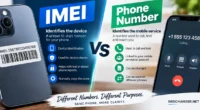
Does a MEID Have Anything to Do With a Phone Number?
Not directly.
A phone number identifies the mobile service associated with a subscriber or account.
MEID identifies the physical cellular equipment.
That distinction remains important even on older CDMA devices.
Changing a mobile service or account does not mean that the physical device suddenly receives a new MEID. The equipment identifier belongs to the device, while the subscriber relationship is handled separately.
This is the same basic principle that makes device identifiers different from phone numbers, even though both can appear in information associated with the same handset.
Does MEID Identify the SIM Card?
No.
MEID is a device identifier, not a SIM-card identifier.
This distinction can become confusing on older CDMA equipment because traditional CDMA networks did not always use SIM cards in the same way GSM-based networks did.
That historical difference is one reason terminology from older CDMA phones can look unfamiliar when compared with today’s SIM-and-IMEI model.
On modern phones, several identifiers can coexist:
- IMEI for cellular equipment
- SIM/ICCID information for the SIM
- EID for an eSIM
- Phone number for the mobile service
- Manufacturer serial number for product identification
MEID belongs to a different part of the historical cellular-identifier landscape.
Can You Use a MEID in an IMEI Checker?
Not necessarily.
An IMEI checker is normally designed around IMEI-based information.
If you enter a MEID into a form that specifically expects a 15-digit IMEI, the service may reject it, return no result, or interpret the input incorrectly.
This is not necessarily evidence that the phone is bad.
It may simply mean that you are using the wrong identifier for the database being queried.
Before checking an older phone, identify the exact identifier displayed by the device and determine what the checking service supports.
What If Your Phone Shows an IMEI but You Cannot Check It?
There are several possible reasons.
The number may have been entered incorrectly, the service may not support the particular device or identifier, or the database may not contain the information you are looking for.
If the phone itself displays a valid IMEI, you can start by checking the number carefully and using an appropriate IMEI lookup.
If you are dealing with a used phone, compare the number displayed on the handset with the number provided by the seller.
A mismatch deserves investigation before you spend money.
What If the Device Has No IMEI?
A missing IMEI is a different problem from having an MEID.
Do not automatically conclude that a phone with no visible IMEI has been blacklisted.
A missing or invalid IMEI can be associated with firmware problems, software changes, configuration issues, unsuccessful repairs, modem-related problems, or hardware faults.
If you are working with an Android device and the IMEI is not appearing where expected, see our guide on What To Do If IMEI Is Not Showing On Android.
For broader troubleshooting information, our IMEI Repair Tool guide covers the distinction between checking an identifier and dealing with a legitimate IMEI-related device problem.
Does an MEID Mean the Phone Is Blacklisted?
No.
Simply seeing an MEID does not tell you whether a device has been blacklisted.
The identifier and the device’s status are two separate questions.
A device can have a perfectly valid equipment identifier while still having a network restriction, reported status, carrier issue, or another problem.
Likewise, an identifier being unfamiliar does not automatically mean that the phone is stolen, blocked, or defective.
If you are specifically investigating whether an IMEI-based device has been reported or restricted, use a dedicated blacklist check rather than trying to infer the status from the identifier format alone.
Why the Difference Still Matters Today
For someone buying a brand-new current smartphone, MEID may never appear during normal use.
For someone researching an older phone, however, knowing the difference can prevent several common mistakes.
You may encounter:
- A CDMA-era phone displaying MEID
- An older device referencing ESN
- A multi-technology phone containing different equipment identifiers
- A seller incorrectly calling every device identifier an IMEI
- A checking website that accepts only IMEI
- A repair guide that uses terminology specific to older CDMA hardware
Without understanding the history, these situations can look like errors.
With the history, they make much more sense.
IMEI vs MEID: Which One Should You Use?
The answer depends on the identifier your device actually uses and what you are trying to check.
If the phone provides a 15-digit IMEI, use the IMEI when an IMEI-based service is required.
If an older CDMA device provides an MEID, do not simply convert or substitute it because an online form happens to ask for an IMEI. Find a service or database that supports the identifier you actually have.
If your goal is to investigate a used phone’s device information, begin with the identifier displayed by the phone itself.
If your goal is to investigate blacklist status, use the appropriate device-status checking resource.
If the problem is a missing or invalid IMEI, treat it as a troubleshooting issue rather than assuming that the presence of MEID is the cause.
Final Takeaway
IMEI and MEID were created to solve a similar fundamental problem: identifying cellular equipment.
The difference is in the technology and numbering systems behind them.
IMEI is the familiar 15-digit device identifier used throughout GSM-family and modern 3GPP cellular ecosystems. MEID was developed for CDMA2000 equipment and is commonly encountered in hexadecimal form on older CDMA-era devices.
So if you find an MEID on an older phone, there is no reason to assume that it is a defective IMEI or a strange serial number. It is a different type of equipment identifier with its own history and technical purpose.
The practical rule is simple: identify the number your phone actually displays before choosing a checker, lookup service, or troubleshooting guide.
That small step can prevent you from using the wrong database, misreading an older device, or assuming that a normal CDMA identifier is a problem.
For modern IMEI-based device research, start with the IMEI Lookup Tool. If you are investigating whether a device has a reported status, use the IMEI Blacklist Checker. And if an Android phone has lost or stopped displaying its IMEI, use the IMEI troubleshooting guide before attempting further changes.