
EID vs ICCID: What Is the Difference?
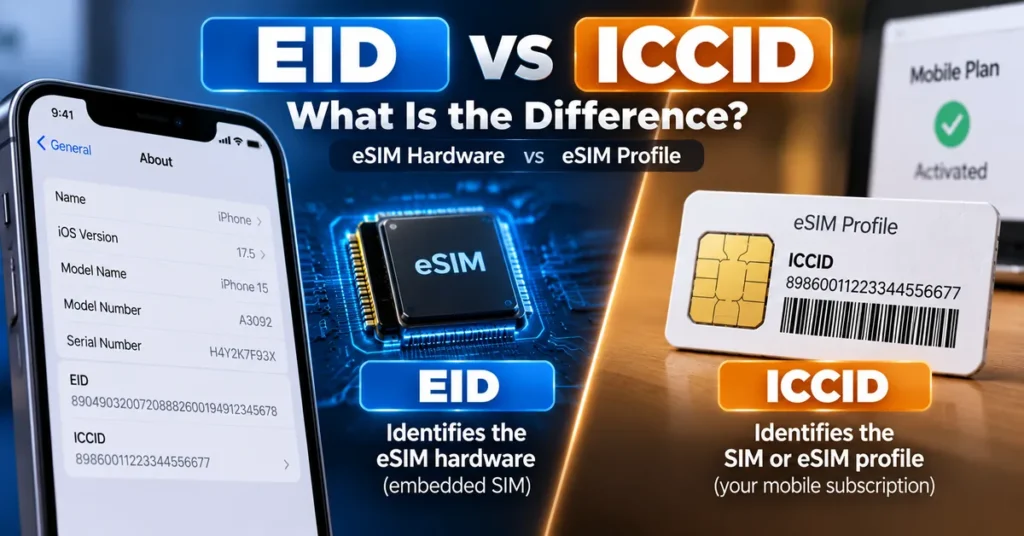
EID vs ICCID is a common source of confusion when setting up or troubleshooting an eSIM because both numbers can appear in the same phone settings. They are related to eSIM technology, but they identify different things. The EID identifies the embedded SIM hardware inside the device, while the ICCID identifies a particular SIM or eSIM profile.
That difference becomes especially important when a carrier asks for one of these numbers during eSIM activation. Giving the ICCID when the carrier requested the EID, or vice versa, can lead to unnecessary confusion.
The easiest way to understand the relationship is to stop thinking of EID and ICCID as two versions of the same number. They belong to different layers of the eSIM system.
EID and ICCID in One Sentence
If you only need the quick answer:
EID identifies the eSIM hardware. ICCID identifies the SIM or eSIM profile.
An eSIM-capable phone can therefore have an EID and one or more ICCIDs at the same time.
Think of it like this:
EID → eSIM hardware
ICCID → eSIM profile
The hardware provides the environment in which profiles can be installed and managed, while the ICCID identifies the individual profile.
If you are unfamiliar with EID itself, our guide What Is an EID Number on a Phone? provides the broader explanation.
What Is an EID?
EID refers to the identifier associated with an eUICC, the embedded SIM component used for eSIM functionality.
Unlike a traditional removable SIM card, an eSIM does not require you to physically insert a new plastic card every time you want to install another compatible mobile profile.
The EID identifies the embedded SIM hardware that supports this process.
This is why an EID is tied much more closely to the device’s eSIM capability than to an individual mobile subscription.
What does the EID identify?
The EID identifies the embedded SIM component rather than the particular cellular plan currently installed.
This distinction is important because one eSIM-capable phone can potentially have different eSIM profiles installed or managed over time.
The EID belongs to the underlying eSIM hardware.
When might a carrier ask for the EID?
A carrier may request the EID during an eSIM activation or provisioning process.
For example, if you are moving a mobile plan to a new eSIM-capable phone, the carrier may need the EID to identify the device’s eSIM hardware.
That does not mean the EID is the same thing as your mobile plan’s identifier.
What Is an ICCID?
ICCID stands for Integrated Circuit Card Identifier.
It is associated with a SIM or an individual eSIM profile.
With a traditional physical SIM, the ICCID is associated with the SIM card.
With eSIM technology, an ICCID can identify a specific profile installed or provisioned for cellular service.
This is why ICCID belongs on the profile side of the comparison.
For a complete explanation of ICCID, see What Is an ICCID Number?.
What does the ICCID identify?
The ICCID identifies the SIM or eSIM profile rather than the phone’s embedded eSIM hardware.
That means the ICCID can be different when the cellular profile changes even though the underlying phone has not changed.
This is one of the most useful differences to remember.
The Best Way to Visualize EID vs ICCID
Imagine an eSIM-capable smartphone as a device containing an embedded SIM component.
The EID identifies that embedded component.
Now imagine that a carrier provisions a mobile profile onto it.
The ICCID identifies that particular profile.
So the relationship looks roughly like this:
Phone
↓
Embedded eSIM hardware
↓
EID
↓
Installed eSIM profile
↓
ICCID
This is why both numbers can exist on the same device without identifying the same thing.
EID vs ICCID: Side-by-Side Comparison
| Feature | EID | ICCID |
|---|---|---|
| Identifies | eSIM/eUICC hardware | SIM or eSIM profile |
| Associated with | Embedded SIM component | Cellular profile |
| Used with physical SIM? | No | Yes |
| Used with eSIM? | Yes | Yes |
| Can be associated with multiple profiles? | Yes, depending on device/eSIM configuration | Each profile has its own identifier |
| Typically relevant to eSIM provisioning? | Yes | Sometimes |
| Identifies the phone itself? | No | No |
| Same as IMEI? | No | No |
The key difference is therefore hardware versus profile.
Why Can Both Numbers Appear on the Same Phone?
Modern smartphones often display several identifiers together.
On an eSIM-capable iPhone, for example, the About section can show information such as EID, ICCID, IMEI and IMEI2.
That does not mean these numbers have overlapping purposes.
Apple treats them as separate device and SIM-related identifiers.
You can learn more about locating EID on an iPhone in our guide How to Find EID Number on iPhone.
The same principle applies to Android phones, although manufacturers organize the information differently. Our guide How to Find EID Number on Android covers the Android side.
What Happens to the EID When You Change Your eSIM?
This is one of the easiest ways to understand the difference.
Suppose you have an eSIM-capable smartphone and install a cellular profile from Carrier A.
The phone has its EID.
The installed profile has its ICCID.
Later, you remove that profile and install another profile from Carrier B.
The phone’s underlying eSIM hardware has not been replaced.
Therefore, the EID remains associated with the same embedded SIM hardware.
The new profile can have a different ICCID.
So, in simplified form:
Same eSIM hardware → same EID
Different eSIM profile → potentially different ICCID
This is the central relationship between the two identifiers.
Can One EID Be Associated With Multiple ICCIDs?
An eSIM-capable device can support multiple profiles, depending on the hardware, software, carrier and configuration.
Each individual profile can have its own identifying information, including an ICCID.
The EID, however, continues to identify the underlying eSIM hardware.
That means you should not expect the EID and ICCID to have a one-to-one relationship in every situation.
A better model is:
One eSIM hardware identity → potentially multiple profiles over time
Each profile can have its own ICCID.
EID Is Not Your Phone Number
Another common mistake is assuming that the EID identifies your mobile service.
It does not represent the telephone number you give to friends, customers, or other contacts.
Your phone number is assigned as part of your mobile service.
The EID identifies the eSIM hardware.
The ICCID identifies the SIM or eSIM profile.
These are three different concepts.
This distinction becomes particularly useful when a carrier support representative asks for information and gives you a specific identifier to locate.
EID Is Not the IMEI Either
Because EID and IMEI can appear together in phone settings, users sometimes assume that one is simply an eSIM version of the other.
It is not.
The IMEI identifies cellular equipment.
The EID identifies the embedded SIM hardware.
The ICCID identifies the SIM/eSIM profile.
If you want to understand all three at once, our broader IMEI vs EID vs ICCID comparison puts the identifiers into a single framework.
The important point for this article is that EID and ICCID should not be substituted for IMEI when a service specifically requests the device identifier.
EID vs ICCID During eSIM Activation
This is where the distinction becomes practical rather than theoretical.
Imagine that you purchase a new eSIM-capable phone and want to activate your mobile service.
The carrier may ask for information that identifies the device’s eSIM capability.
In some activation workflows, the EID is important because it identifies the eSIM hardware.
The carrier may also use information associated with the eSIM profile itself.
If the activation process specifically asks for an ICCID, use the ICCID.
If it asks for an EID, use the EID.
Do not assume that one can automatically replace the other.
Why entering the wrong number causes problems
EID and ICCID are long numeric identifiers that can look almost identical at first glance.
If you copy the wrong one into an activation form, the carrier system may not be able to match the information to the expected device or profile.
When dealing with activation, always follow the carrier’s exact instructions.
Where to Find EID and ICCID on iPhone
On many iPhones, the easiest starting point is:
Settings → General → About
Depending on the iPhone model and cellular configuration, you may see:
- EID
- ICCID
- IMEI
- IMEI2
- Serial number
Because these numbers can appear close together, take care when copying one.
If your goal is specifically to find ICCID, our guide How to Find ICCID on iPhone and Android provides the platform-specific steps.
Where to Find EID and ICCID on Android
Android is less standardized than iOS when it comes to Settings menus.
Depending on the manufacturer, you may find eSIM and SIM information under:
Settings → About phone
or:
Settings → About phone → SIM status
Other phones may place the information under SIM management, network settings, or a status screen.
If you need the EID specifically, start with our Android EID guide.
For ICCID, use the ICCID guide for iPhone and Android.
The exact menu can vary according to the manufacturer, Android version and carrier configuration.
What If You Can See the EID but Not the ICCID?
This situation can occur because the two identifiers have different roles.
The EID belongs to the embedded eSIM hardware.
The ICCID is associated with a SIM or eSIM profile.
If an eSIM profile is not currently active, has been removed, or is not being exposed through the device’s current interface, the ICCID may not be displayed in the same way.
This does not necessarily mean that the eSIM hardware is defective.
Check the phone’s SIM and cellular settings and, if necessary, contact the carrier that provided the profile.
What If You Can See the ICCID but Not the EID?
The reverse situation can also be confusing.
If a phone is displaying SIM information but you cannot locate an EID, first confirm that the device actually supports eSIM.
A physical SIM does not require an EID in the same way an embedded eSIM component does.
On supported phones, the EID may be shown in device information or SIM-related settings.
If you are unsure whether the number you found is an EID, compare it with the instructions in our What Is an EID Number on a Phone? guide.
Does Replacing a Physical SIM Change the EID?
No, because a physical SIM replacement does not replace the phone’s embedded eSIM hardware.
The EID belongs to the device’s eSIM component.
A physical SIM has an ICCID associated with it.
Replacing the physical SIM can therefore result in a different ICCID while leaving the EID unchanged.
This is another useful example of why the two numbers cannot be treated as interchangeable.
Does Replacing a SIM Change the ICCID?
It can.
If you replace one physical SIM with another, the new SIM can have a different ICCID.
The same principle applies when switching between different eSIM profiles.
The phone may remain exactly the same while the active SIM or eSIM profile changes.
This is why an ICCID should be viewed as belonging to the SIM/profile layer, not the handset.
EID vs ICCID vs Phone Number
These three pieces of information are sometimes mixed together because they all relate to cellular service.
But they answer different questions.
| Information | What it tells you |
|---|---|
| EID | Which embedded eSIM hardware is involved? |
| ICCID | Which SIM/eSIM profile is involved? |
| Phone number | Which telephone number is assigned to the service? |
A phone number can potentially change while the device remains the same.
An ICCID can change when the SIM or eSIM profile changes.
The EID remains associated with the embedded eSIM hardware.
That separation makes troubleshooting much easier.
EID vs ICCID When Buying a Used Phone
If you are buying a used smartphone, knowing the difference can prevent you from checking the wrong information.
The EID tells you about the phone’s eSIM hardware.
The ICCID tells you about a SIM or eSIM profile.
Neither should be treated as a substitute for checking the phone’s IMEI when your concern is whether the handset itself has a reported blacklist status.
For that purpose, you can use our IMEI Blacklist Checker.
A clean or visible ICCID does not automatically mean that the phone’s IMEI is clean.
They are answering completely different questions.
Can an ICCID Be Calculated From an EID?
No.
The EID and ICCID are separate identifiers serving different purposes.
You should not attempt to generate an ICCID from an EID or assume that one number can be mathematically converted into the other.
If you need an ICCID, retrieve the actual identifier associated with the relevant SIM or eSIM profile.
If you need an EID, retrieve the EID from the compatible device.
Can an Online IMEI Tool Find an EID or ICCID?
An IMEI lookup is not a universal lookup system for every identifier stored inside a smartphone.
IMEI-related tools are focused on device identification and information associated with the IMEI.
EID and ICCID belong to different layers.
For example, an IMEI lookup cannot normally tell you which eSIM profile is currently installed simply because you know the phone’s IMEI.
If you need device-related IMEI information, you can use our IMEI Lookup Tool for iOS and Android.
For ICCID, look directly at the phone’s SIM/eSIM information or contact the carrier associated with the profile.
The Simplest Way to Remember EID vs ICCID
Forget the long technical names for a moment.
Ask:
“Am I identifying the eSIM hardware or the cellular profile?”
If you are identifying the eSIM hardware, you want the EID.
If you are identifying the SIM/eSIM profile, you want the ICCID.
So the memory shortcut is:
EID = hardware
ICCID = profile
That is the distinction that matters most.
Frequently Asked Questions
Is EID the same as ICCID?
No. EID identifies the embedded eSIM hardware, while ICCID identifies a SIM or eSIM profile.
Which is more important, EID or ICCID?
Neither is universally more important. They serve different purposes. The correct one depends on what your carrier, device, or activation process is asking for.
Can an iPhone have both EID and ICCID?
Yes. An eSIM-capable iPhone can display both because they identify different parts of the cellular system.
Can an Android phone have both EID and ICCID?
Yes, on compatible eSIM-capable Android devices. The exact location of the identifiers depends on the manufacturer and software.
Does the EID change when I change my eSIM?
Changing the eSIM profile does not mean that the underlying eSIM hardware has been replaced. The EID is associated with that embedded hardware, while the profile can have its own ICCID.
Can the ICCID change?
Yes. Replacing a physical SIM or changing an eSIM profile can result in a different ICCID.
Is ICCID the same as my phone number?
No. ICCID identifies the SIM or eSIM profile. The phone number is the number assigned to the mobile service.
Is EID the same as IMEI?
No. EID identifies eSIM hardware, while IMEI identifies the cellular device.
Which number do I give my carrier?
Give the exact identifier the carrier requests. If they ask for EID, provide EID. If they ask for ICCID, provide ICCID.
Final Takeaway
The difference between EID and ICCID becomes much clearer when you look at the layer each identifier belongs to.
The EID identifies the embedded eSIM hardware inside a compatible device.
The ICCID identifies the SIM or individual eSIM profile used for cellular service.
That means a single eSIM-capable phone can have one EID while using different eSIM profiles over time, with each profile having its own ICCID.
So when you see both numbers in your phone’s settings, remember:
EID = the eSIM hardware.
ICCID = the SIM/eSIM profile.
They work together, but they are not interchangeable.